Opinion: India, Putin and the fractured geopolitics
Putin’s visit to New Delhi did not signal a return to Cold War nostalgia or a departure from the West; it was India reminding the world that its strategic autonomy is intact


By Geetartha Pathak
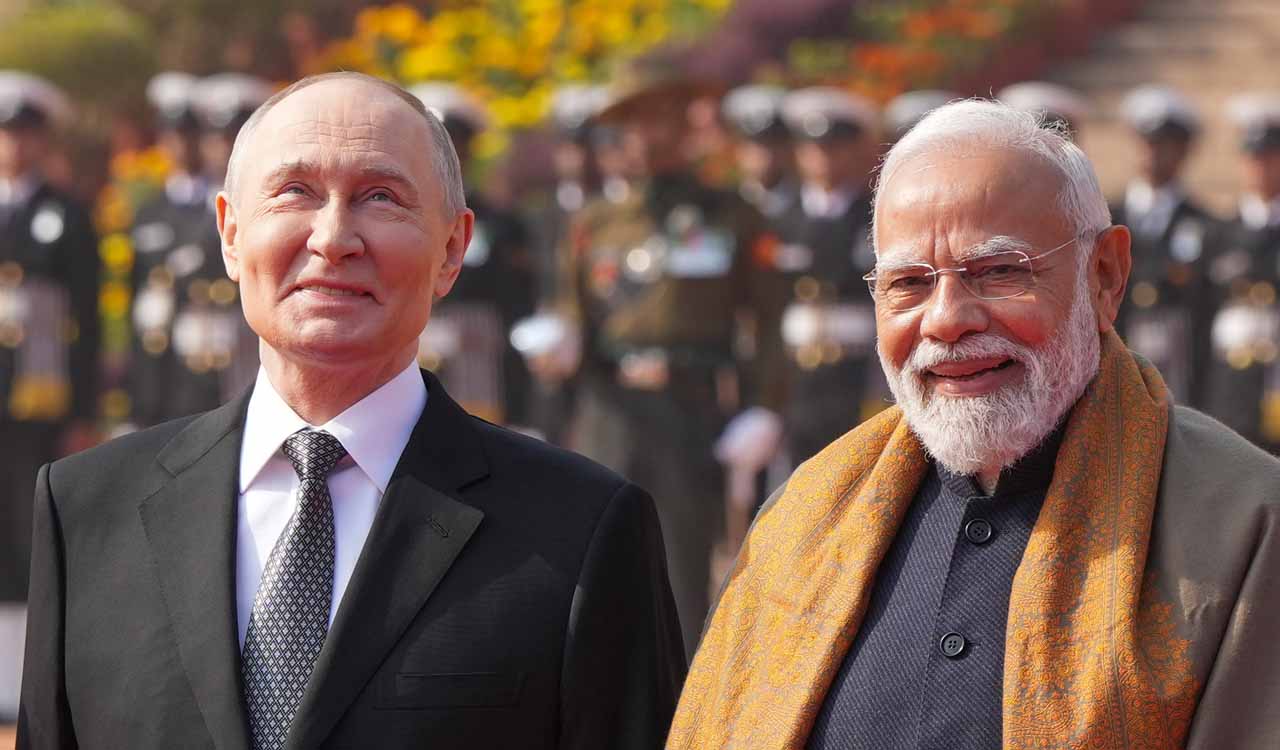
Russian President Vladimir Putin’s arrival in New Delhi on 4-5 December 2025 for the 23rd India-Russia Annual Summit marked his first bilateral visit since the 2022 invasion of Ukraine. The optics followed a familiar choreography — a private dinner, wreath-laying at Rajghat, restricted talks, and multiple agreements on nuclear energy, shipping, aviation, and artificial intelligence. Yet behind this ritualised warmth lay a far more complex strategic moment. What unfolded in Delhi was not a replay of Soviet-era camaraderie but an exercise in hard realism as the world enters an era of fractured geopolitics.
Also Read
India’s historical affinity for Moscow remains strong. Russia still accounts for about 60 per cent of India’s defence inventory and has long been a reliable partner at forums like the UN Security Council on issues such as Kashmir. Public sentiment continues to favour Russia: a 2024 YouGov–Mint survey found 54 per cent of Indians viewing Russia positively — the highest among major democracies.
Multi-aligned Power
But the India of 2025 is no longer a Cold War-era dependent. It is a multi-aligned power with expanding ties to the West and Indo-Pacific democracies. The Quad has matured into a platform for maritime security and critical-technology cooperation. India’s defence relationship with the United States has deepened through foundational agreements like COMCASA and BECA, co-production of GE F-414 jet engines, and the iCET technology initiative. France has become a trusted supplier of aircraft and submarines; Israel provides drones and cyber tools; Japan and Australia are advancing new defence collaborations. India’s diversification is deliberate —and accelerating.
Putin’s visit came just weeks after the second Trump administration imposed steep tariffs on Indian exports and criticised New Delhi’s continued purchase of discounted Russian crude. Washington’s message was explicit: cheap Russian oil undercuts sanctions and indirectly fuels Moscow’s war machine. New Delhi’s position was equally clear — energy security is sacrosanct. In 2023–24 alone, discounted crude saved India an estimated $7–9 billion and cushioned domestic inflation.
Russia-China
The deeper structural concern for India is Russia’s growing dependence on China. Bilateral trade between Moscow and Beijing crossed USD 240 billion in 2024, with the renminbi dominating settlements. Russia is increasingly tied to China as a supplier of raw materials while relying on Chinese machinery and dual-use components. Military cooperation has intensified, with joint patrols in the Pacific and cooperation on advanced missile systems. Reports of Chinese volunteers and North Korean ammunition entering the Russian war effort only underscore Moscow’s vulnerability.
With Moscow drifting into Beijing’s orbit, India must preserve strategic autonomy through principled diplomacy, wider defence ties and energy pragmatism
For India, a Russia that becomes a junior partner to China erodes its strategic utility. India has long valued Moscow for access to high-end military platforms unavailable to Beijing. But if Russia becomes structurally dependent on China, India’s ability to secure a stable balance along the Line of Actual Control weakens. It also risks a coordinated two-front challenge.
This strategic anxiety explains New Delhi’s determination to stay engaged with Moscow. The summit yielded agreements on shipbuilding, defence production, faster S-400 deliveries, and expanded nuclear cooperation, including potential Russian participation in India’s small modular reactor programme. Russia has also expressed willingness to transfer technology for the Su-57E stealth fighter, an option India sees as a hedge against delays in its own AMCA project.
Yet these engagements cannot mask the strain on Russia’s defence industry. The Ukraine war has disrupted supply chains; deliveries have slipped; spare parts for Soviet-era platforms often arrive late. The battlefield performance of Russian armour and air-defence systems — under sustained Western precision-strike pressure — has raised uncomfortable questions about the survivability of systems India relies on.
As a result, New Delhi has pushed harder on diversification: the Air Force’s global tender for 114 multirole fighters, additional Scorpene submarines for the Navy, and indigenous projects like Zorawar light tanks and the Future Infantry Combat Vehicle.
Energy remains the strongest pillar of the contemporary relationship. India-Russia trade reached USD66 billion in FY 2024–25, driven overwhelmingly by crude imports. Payments remain difficult due to sanctions, and both sides are experimenting with rupee-rouble mechanisms, third-country banks, and even cryptocurrency pilots. A dedicated channel between National Security Adviser Ajit Doval and his Russian counterpart Nikolai Patrushev is reportedly working on sanction-resistant architectures.
The reputational challenge is harder to manage. Hosting Putin with full honours while an ICC arrest warrant hangs over him risks weakening India’s claim to champion a rules-based order. Western analysts increasingly frame India’s Ukraine stance as “transactional neutrality.” Europe may further slow negotiations on free-trade agreements. Semiconductor and high-tech collaborations—where the West and its partners hold leverage—could face subtle hesitation over reputational risks.
Domestic politics also shapes the optics. For a large section of voters, Modi’s embrace of Putin reinforces a narrative of strategic autonomy and defiance of Western pressure. But younger, globally connected Indians increasingly express discomfort with images of bonhomie while Ukraine remains under assault.
What should India’s approach be?
First, clarity on principles. India has consistently upheld sovereignty and territorial integrity. It must continue urging diplomacy on Ukraine more assertively, silence is now interpreted as complicity.
Second, use Russia to balance China. Engagement with Moscow remains essential not out of nostalgia but as a geopolitical necessity. Deeper economic cooperation, faster defence deliveries, and joint projects in the Russian Far East and Arctic help maintain Russian options beyond Beijing. New Delhi must also speak frankly with Moscow about China’s assertiveness in Asia.
Third, accelerate diversification. Russia’s share of India’s defence imports has fallen from 76 per cent in 2009-13 to about 36 per cent in 2019-23. By 2035, the aim should be to reduce this to 20-25 per cent, while ramping up partnerships with the US, Europe, Israel, and domestic industry.
Fourth, pursue energy pragmatism without triggering secondary sanctions. India should adopt secure payment and insurance mechanisms before expanding purchases of Russian crude. Parallel investment in the US and Middle Eastern energy, as well as renewables, will be essential.
Inviting Putin to Rajghat — the memorial to Mahatma Gandhi — was symbolically potent. India must ensure the message remains one of peace and dialogue rather than tacit acceptance of aggression. Putin’s visit did not signal a return to Cold War nostalgia or a departure from the West; it was India reminding the world that its strategic autonomy is intact.
As great powers polarise the global system, India’s ability to maintain open channels with all, without being subsumed by any, remains its greatest asset. The more Washington pressures New Delhi, the more room Moscow will retain to court it, and vice versa. In an age of tariff wars, contested technologies, and proxy conflicts, India must protect its vital interests — security, energy, technology, and economic growth — while upholding the democratic values that distinguish it from the authoritarian axis it seeks to balance.
If India navigates this crossroads with clarity and principle, it can emerge not merely as a swing power but as a pole in its own right in the emerging multipolar world.
(The author is a senior journalist from Assam)

Related News