Opinion: Skipping a Master’s degree may weaken research quality
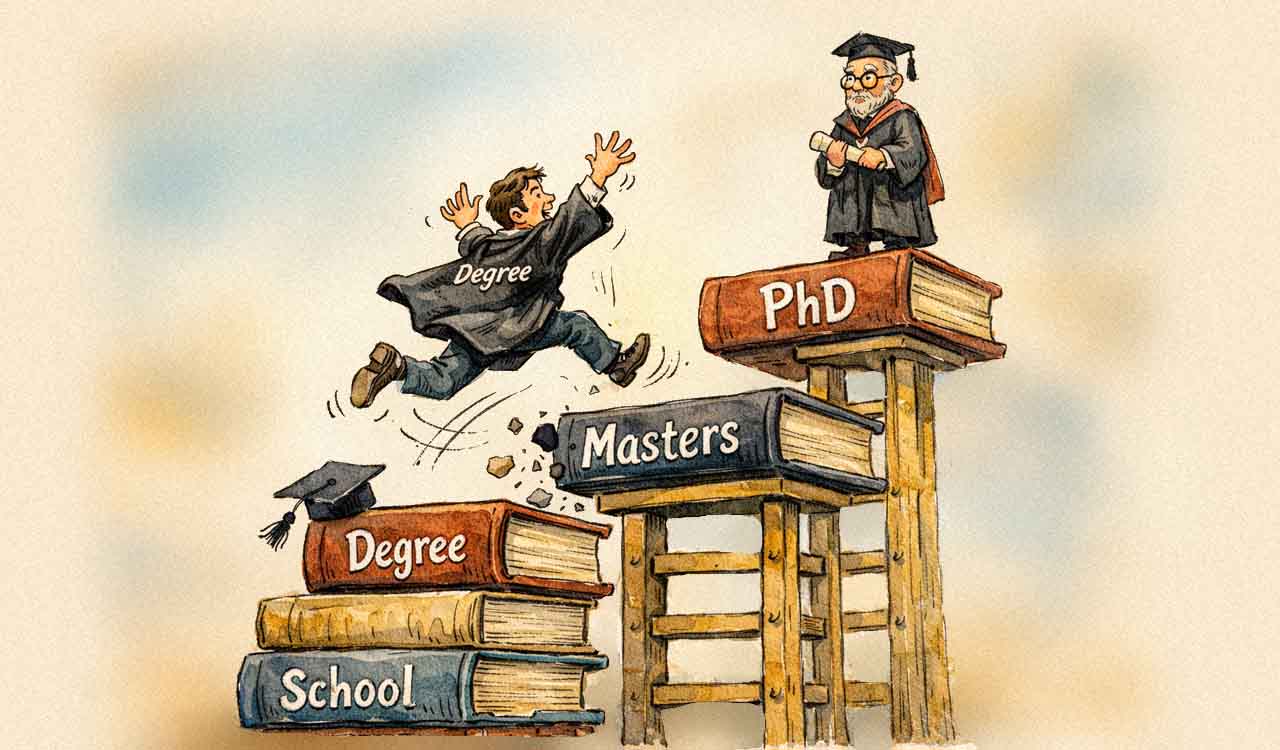
India’s new policy allowing direct PhD entry after a four-year Bachelor’s degree raises concerns about research rigour


By MJ Gerard Rassendren, Neeraj Kumar
A recent education policy allows students with a four-year bachelor’s degree and 75 per cent marks to directly appear for NET and seek admission to PhD programmes, effectively bypassing a Master’s degree. This marks a significant shift in the structure of higher education.
Also Read
Traditionally, education has been viewed not merely as skill training but as a gradual process of intellectual development. The question now is whether skipping postgraduate study reduces higher education to professional training rather than holistic academic formation. To understand this issue, it is helpful to briefly examine the historical role of the Master’s degree and its contributions to a student’s academic journey.
Setting them Apart
The idea of the master’s degree dates back to medieval Europe, when the distinction between Master’s and doctoral studies was not always clearly defined. Over time, particularly by the early nineteenth century, universities began separating postgraduate and doctoral study into distinct phases. Germany played a key role in shaping this structure through what came to be known as the Humboldtian model of higher education.
For nearly two centuries, this three-tier system — undergraduate, postgraduate and doctoral study — has been widely accepted, reflecting the belief that advanced learning requires progressive stages of intellectual development. A Master’s programme often provides the first structured exposure to research-oriented study, helping students deepen their understanding of the subject, integrate prior learning, and engage in independent reading, academic writing and, in many cases, dissertation work. Such training strengthens academic foundations and introduces intellectual rigour that goes beyond classroom learning.
This becomes particularly relevant in the context of four-year undergraduate programmes that may already include a research component. Even then, Master’s-level study typically advances both knowledge and research engagement well beyond foundational undergraduate training.
While an extended undergraduate programme may build confidence, a Master’s programme usually fosters deeper specialisation, cognitive maturity and a clearer professional identity. These experiences contribute not only to academic expertise but also to personal and intellectual development that are difficult to replicate elsewhere.
Seen in this light, the current policy allowing direct PhD entry based mainly on fourth-year performance and a qualifying test may not fully capture the broader preparation that postgraduate study traditionally provides.
Research Output
A PhD programme, by contrast, is largely based on independent study with limited taught coursework. The supervisor mainly provides guidance, while the student is expected to develop expertise in a specific research area and contribute new knowledge. Some may argue that countries like the United States allow direct entry into doctoral programmes after undergraduate study. However, such pathways usually involve structured intermediate coursework and qualifying examinations before full doctoral candidacy. The final undergraduate year is, therefore, not treated as equivalent to Master’s-level preparation.
A Master’s programme often provides the first structured exposure to research-oriented study, helping students deepen subject knowledge and develop independent reading, writing, and dissertation skills
This context makes it important to reflect on the broader state of research output as well. A 2023 Nature report noted that while India ranked third globally in the number of research publications, its citation impact remained comparatively low, with around 30 per cent of papers reportedly receiving no citations. This raises concerns about research rigour. In such a context, bypassing Master’s-level preparation could risk weakening research quality rather than strengthening it.
Striking a Balance
What is being argued is that there is a critical need to balance increasing the speed of research careers with maintaining academic rigour. Moving directly from a Bachelor’s degree to a PhD may create gaps in specialised theoretical knowledge, even among highly motivated students. If policy continues to allow direct entry after a four-year honours degree, certain structural safeguards could help bridge this gap.
These may include intensive preparatory coursework in advanced theory, participation in Master’s-level seminars to foster academic discourse, a transitional research paper phase to develop independent study habits, structured training in rigorous academic writing, and a comprehensive qualifying examination before formal PhD candidacy. These measures highlight the continuing importance of Master’s-level preparation in building research readiness.
In effect, most higher education systems recognise the importance of Master’s-level study in developing deeper knowledge, specialised expertise and intellectual maturity. The three stages of higher education — undergraduate, postgraduate and doctoral — represent progressive levels of learning and research preparedness.
Compressing this structure into only two phases may risk weakening academic foundations. Education policy must, therefore, balance the desire for faster research pathways with the need to sustain academic rigour. The long-term quality of research, and ultimately the intellectual strength of the nation’s youth, depends on getting this balance right.
(MJ Gerard Rassendren is Associate Professor and NeerajKumar is Assistant Professor, Department of Economics, School of Social Sciences, CHRIST (Deemed to be University), Bengaluru)

Related News