Opinion: India’s Free Trade Agreement push
With 15 FTAs in force and a few under negotiation, India’s trade success will depend not just on signing agreements, but also on how it leverages them to drive growth, competitiveness, and global integration


By Dr Charu Grover Sharma
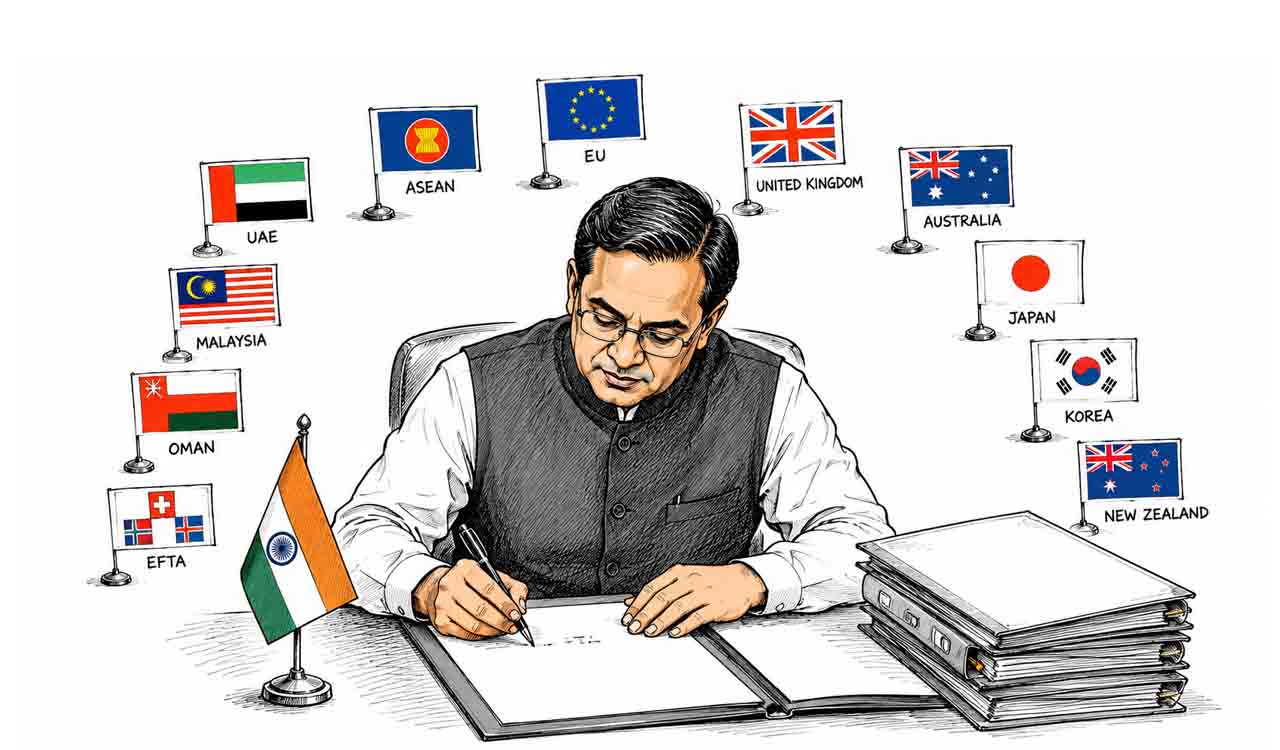
India’s trade policy has seen a significant shift over the last five years. The government has signed free trade agreements (FTAs) with the UAE, Australia, the United Kingdom, the four EFTA nations, Oman, New Zealand, and the European Union. The EU agreement is a major milestone signed after about two decades of negotiations. The nine recently signed FTAs will be fully operational within the next ten months, while three to four agreements are under negotiation.
Also Read
India has 15 FTAs in operation covering 27 countries, accounting for more than 75% of its total trade. Since economic liberalisation, the country has never witnessed such extensive trade integration, and now enjoys preferential market access for its goods in major economies.
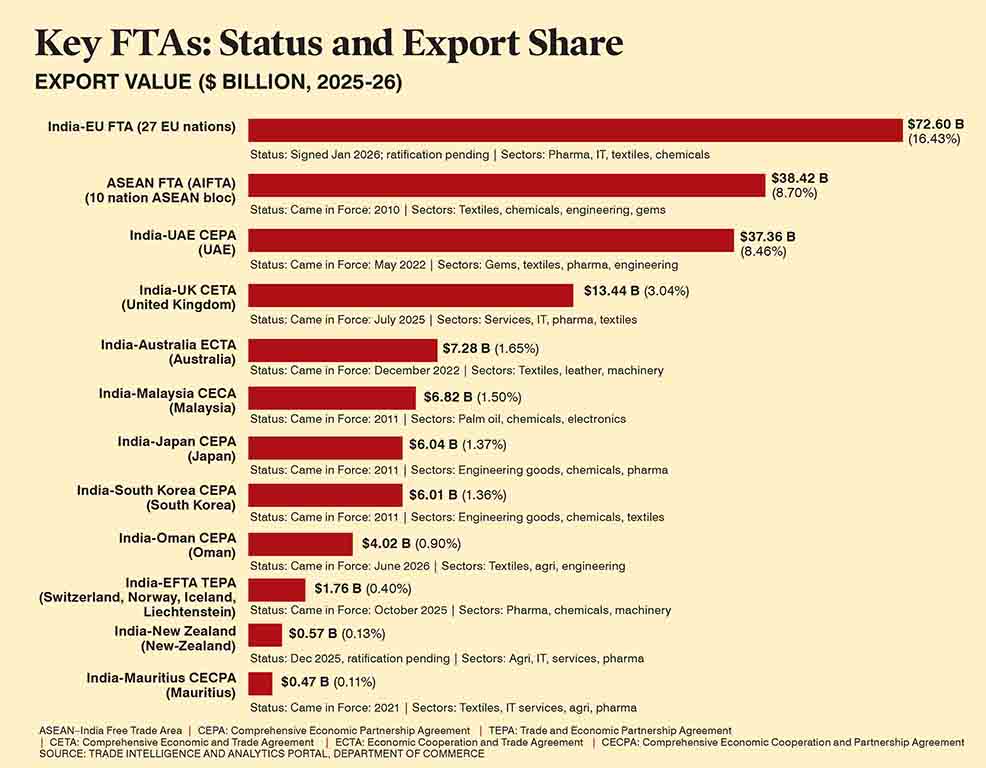
The India-UAE Comprehensive Economic Partnership Agreement (CEPA) came into force in May 2022 and eliminated duties on Indian goods such as textiles, gems and jewellery, engineering goods, and pharmaceuticals. Indian merchandise exports to the UAE grew by more than 20%, from $28.4 billion in 2021-22 to $37.36 billion in 2024-25 (Trade Intelligence and Analytics Portal, Ministry of Commerce).
Similarly, the India-Australia Economic Cooperation and Trade Agreement (ECTA), which came into force in December 2022, granted duty-free access across 100% of tariff lines for Indian exporters. India’s exports to Australia increased by more than 80%, from $4 billion in 2021-22 to $7.3 billion in 2025-26 (Trade Intelligence and Analytics Portal, Ministry of Commerce). Sectors such as textiles, leather, machinery, and processed food—where India has a comparative export advantage — are expected to benefit from the agreement.
The FTA with EU, once ratified, will be the largest trade agreement India has ever entered. The EU is India’s second-largest trading partner. Preferential access to 27 European markets for Indian pharmaceuticals, IT services, textiles, chemicals, and agri-processed goods will strengthen India’s export competitiveness over the long term.
Trade Deficits in Context
Critics argue that trade agreements have not delivered as they have contributed to widening trade deficits with partner countries. However, the data require a more careful reading. India has recorded an average annual trade deficit of about $62 billion with ASEAN, Japan, and South Korea over the past three years. But, a significant proportion of these imports comprises industrial inputs such as semiconductors, electronic components, capital equipment, and speciality chemicals, all of which are essential for domestic manufacturing.
India’s merchandise exports increased 40.6% from 2021-22 to 2025-26, from $314 billion to $441.7 billion, respectively. The total merchandise and service exports together touched $860 billion in 2025-26 (Department of Commerce). The government is well on track to meet its Foreign Trade Policy 2023 target of $ trillion in merchandise exports by 2030 through the signing of these FTAs.
Utilisation and Structural Gaps
FTA utilisation among Indian exporters remains below its potential. To address this, the Trade Connect ePlatform has been established to help exporters identify FTA benefits. Further, MSME outreach programmes should reach smaller exporters to enable them to take advantage of preferential trade arrangements.
While challenges such as trade deficits, low utilisation and inverted duty structures remain, effective implementation could help India achieve its long-term export growth and global trade objectives
India also faces challenges arising from an inverted duty structure (when import duties on raw materials are higher than on finished products, making it costlier to manufacture locally) in several sectors. Raw materials such as steel and aluminium attract Most Favoured Nation duties of 7.5–10% when imported. But finished goods manufactured using these inputs — machinery, industrial equipment, engineering products — can enter India at zero or low duty under FTAs with ASEAN, Japan, South Korea, the UAE, and Australia.
The focus should be on sectors where raw material import costs are higher than those on finished products. Addressing these anomalies is essential to ensure that FTAs benefit domestic manufacturers, not just importers.
Beyond the economics, India’s FTAs are helping deepen strategic partnerships with the EU, UK, UAE, and Australia in defence, technology, and geopolitics. The India-EU FTA, in particular, marks India’s arrival as an equal negotiating partner within the world’s most complex and standards-intensive trade framework.
The FTA push has transformed India’s position in global trade negotiations. Trade deficits with some partners remain significant, utilisation rates need improvement, and structural issues such as inverted duties are yet to be resolved. Nevertheless, the overall direction is positive, and the pace has been unprecedented. How India leverages these agreements will matter as much as the agreements themselves.

(The author is Assistant Professor, Indian Institute of Foreign Trade, Delhi)

Related News