Opinion: Nehru, and now KCR — The politics of erasing nation-builders
On trial are not individuals, but history itself — and history, time and again, has proven resilient


By Pendyala Mangala Devi
Politics is never merely a contest for power. At its deepest level, it is a struggle over history, memory, and moral legitimacy. As George Orwell warned, “Who controls the past controls the future.” The systematic questioning of leaders who shaped history is, therefore, not accidental; it is a deliberate political strategy aimed at appropriating the past to dominate the future.
Also Read
India has witnessed this phenomenon before. Jawaharlal Nehru, one of the principal architects of modern India, was subjected to sustained political delegitimisation decades after India’s independence. Today, the same political script is being replayed in Telangana against K Chandrashekhar Rao (KCR). This is no coincidence — it is a pattern.
Enduring Paradox
History presents an enduring paradox: those who did not participate in a struggle often attempt to redefine it. Hannah Arendt observed that “great leaders are often judged not by their actions, but by the anxieties they provoke.” India’s freedom struggle was not authored in drawing rooms or television studios; it was written in prisons, protests, and sacrifice. Nehru’s repeated imprisonments, his intellectual leadership, and his role in shaping a constitutional, republican democracy are established historical facts.
Yet, political forces that remained largely absent from the freedom movement— most notably the RSS and its political arm — now question Nehru’s nationalism. This is not a legitimate historical debate; it is an attempt to seize moral ownership over the freedom struggle itself. When one cannot claim sacrifice, one attempts to rewrite sacrifice.
As long as Nehru remains central to India’s national narrative, the foundational legitimacy of the freedom movement cannot be appropriated by those who stood outside it. Hence, Nehru must be converted from a nation-builder into a subject of controversy. This is not about Nehru; it is about controlling the meaning of India.
Telangana and the Manufactured Amnesia
Karl Marx famously remarked that history repeats itself — first as tragedy, then as farce. What was once a tragic assault on the legacy of India’s freedom struggle now reappears as a farcical imitation in Telangana politics.
Telangana was not bestowed by benevolence. It was born of prolonged struggle, sacrifice, and collective assertion of dignity. The question is not rhetorical: Who sustained the Telangana movement across decades? Who transformed scattered protests into a coherent political force? Who carried the struggle from the streets to Parliament and negotiated its constitutional realisation?
The answer is unequivocal: K Chandrashekar Rao.
As BR Ambedkar reminded us, “Leadership is not proclaimed; it is forged in struggle.” KCR’s leadership was neither accidental nor opportunistic. It was shaped through resignations, agitations, mass mobilisations, and relentless political engagement. The Telangana movement was not episodic — it was sustained, and that sustainability came from leadership.
For political actors, who remained peripheral or absent during the movement, to now question KCR’s commitment is not merely ironic; it is intellectually dishonest. This is not a critique — it is historical theft. By attacking the leader, they seek to delegitimise the movement itself.
Moral Authority
Jean-Paul Sartre once wrote, “Moral authority does not emerge from power; it emerges from participation.” Moral legitimacy is earned through shared risk and sacrifice, not through post-facto commentary. When students faced repression, when livelihoods were threatened, and when lives were lost during the Telangana struggle, where were those who now claim moral superiority?
Political memory is not erased by rhetoric. As Frantz Fanon argued, “When a people choose a leader in struggle, that leader becomes part of their collective self.” KCR is not merely a former Chief Minister; he is embedded in the political consciousness of Telangana. To question his commitment is to question the lived experience and democratic judgment of the people themselves.
History does not reside in official files — it lives in collective memory, and no amount of political distortion can erase who fought, who stood firm, and who stayed silent in India’s freedom struggle and Telangana’s statehood movement
Narrative Warfare
There is a consistent political logic at work: when systems cannot be dismantled, symbols are attacked. Nehru built institutions — constitutional democracy, scientific temper, and federal governance. Unable to dismantle these without exposing authoritarian impulses, his critics target his intent.
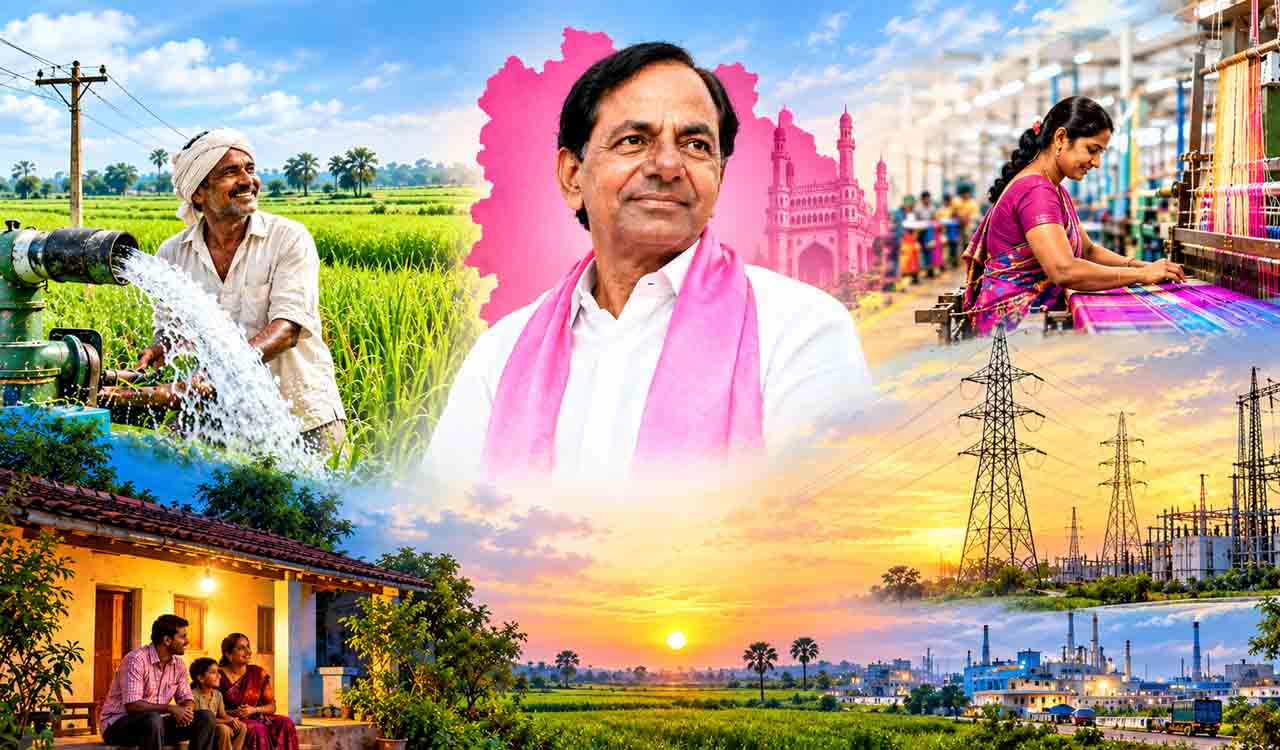
Similarly, KCR built tangible structures in Telangana — irrigation networks, power sufficiency, welfare architecture, and a distinct political identity. These achievements are deeply woven into society. Unable to erase these realities, opponents resort to questioning motives, loyalty, and intent. This is not governance criticism; it is narrative warfare.
History Is Not Govt File
Orwell cautioned that the most effective way to destroy a people is to erase their understanding of their own history. But history does not reside in official files — it lives in collective memory. No amount of political distortion can erase who fought, who stood firm, and who stayed silent.
As long as India remembers its freedom struggle, Nehru will endure. As long as Telangana remembers its movement for statehood, KCR will endure. Governments may change, political fortunes may rise and fall, but the builders of history cannot be legislated out of memory.
Questioning leaders is essential in a democracy. Distorting history is not. What we are witnessing today is not accountability — it is anxiety. Anxiety of those who know that without dismantling history’s builders, they cannot rewrite history itself.
Ultimately, what is on trial is not Nehru. It is not KCR. What is on trial is history — and history, time and again, has proven resilient.

Related News