Opinion: Tamil Nadu crisis — Governor’s discretion or constitutional overreach?
Tamil Nadu Governor Arlekar’s actions revive debate over expanding gubernatorial discretionary powers and federalism


By Shashank Shekhar & Divya Sridhar
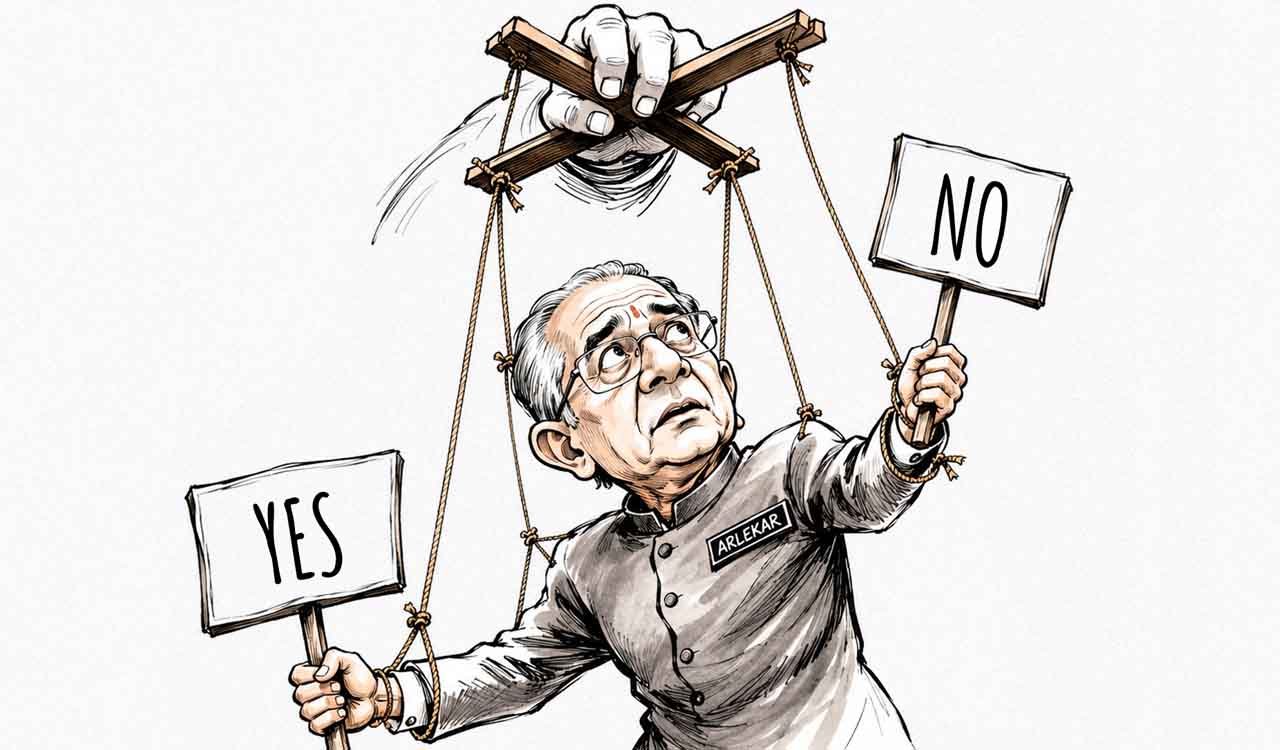
The constitutional controversy in Tamil Nadu involving Governor Rajendra Vishwanath Arlekar and Tamilaga Vettri Kazhagam (TVK) leader C Joseph Vijay has once again brought the role of Governors under intense constitutional scrutiny. Instead of immediately inviting Vijay, whose TVK emerged as the single largest party, to form the government and prove his majority on the floor of the House, the Governor repeatedly demanded signatures of 118 MLAs before administering the oath of office.
Also Read
The controversy is not merely political. It raises deep constitutional questions about the scope of gubernatorial discretion in India. The episode also revives the recommendations of the Sarkaria Commission, Punchhi Commission, and Venkatachaliah Commission, all of which warned against the misuse of the Governor’s office.
Tamil Nadu Controversy
The Tamil Nadu Assembly has 234 seats, and the majority mark is 118. In the 2026 elections, TVK won 108 seats and emerged as the single-largest party. Congress and several smaller parties extended support, but the Governor initially refused to invite Vijay to form the government, claiming that the “requisite majority” had not been established. The Governor’s office justified the decision by stating that constitutional stability required proof of majority before government formation.
Eventually, after letters from supporting MLAs were submitted, Vijay was invited to form the government and sworn in as Chief Minister. However, the delay triggered constitutional criticism and even petitions before the Supreme Court arguing that the Governor had exceeded constitutional limits.
What Does the Constitution Say?
The Constitution of India establishes the office of the Governor under Article 153. Article 164 states that the Chief Minister shall be appointed by the Governor. In situations where no party has a clear majority, the Governor exercises limited discretion in deciding whom to invite to form the government. However, constitutional convention and judicial precedents make one principle clear: the real test of majority is on the floor of the House, not inside Lok Bhavan.
The Constitution nowhere authorises the Governor to conduct a private verification of majority by demanding signatures or proof beyond reasonable satisfaction. The Governor’s role is to identify the person most likely to command confidence and allow the Assembly to decide through a floor test. This principle was firmly established in: SR Bommai v. Union of India (1994); Rameshwar Prasad v. Union of India (2006); Shivraj Singh Chouhan v. Speaker, MP Legislative Assembly (2020).
The Supreme Court repeatedly emphasised that majority must be tested in the Assembly and not determined subjectively by the Governor. Therefore, critics argue that asking Vijay to prove support of 118 MLAs before oath-taking effectively amounted to the Governor conducting a “pre-floor test” outside the legislature itself.
Was Governor Justified?
Supporters of the Governor argue that since TVK lacked an outright majority, the Governor was constitutionally entitled to seek assurance of stable support before inviting Vijay to form the government. Indeed, Governors possess limited discretion in hung Assemblies. Constitutional conventions generally suggest the following order: Pre-poll alliance with majority; Single largest party with support; Post-poll coalition commanding majority; Minority government with outside support. However, discretion is not unlimited. Once the single-largest party demonstrates a plausible claim to majority support, constitutional morality requires that it be allowed to prove majority on the floor of the House.
If Governors begin demanding numerical proof, signatures, or affidavits before oath-taking, the office risks becoming a political checkpoint rather than a constitutional institution
The Governor’s insistence on written signatures and numerical proof before oath-taking appears excessive because it not only substitutes legislative determination with gubernatorial satisfaction but also delays democratic transition and risks transforming the Governor into an active political authority.
Sarkaria Commission
The Sarkaria Commission strongly emphasised that Governors must remain politically neutral and should not misuse discretion during government formation. The Commission recommended that
- The Governor should invite the leader most likely to command majority support.
- Floor tests should determine majority.
- Lok Bhavan should not become the venue for political verification exercises.
Importantly, the Commission warned that Governors should avoid subjective assessments and political manoeuvring.
Punchhi Commission
The Punchhi Commission revisited Centre-State relations and highlighted the growing misuse of gubernatorial discretion. The Commission specifically warned against
- Delays in inviting parties to form government.
- Excessive interference in political processes.
- Governors acting as “agents of the Centre.”
The Commission reaffirmed that: The proper constitutional forum for testing majority is the Legislative Assembly, and Governors should avoid creating constitutional uncertainty. The Tamil Nadu episode closely reflects the exact dangers that the Punchhi Commission anticipated.
Venkatachaliah Commission
The National Commission to Review the Working of the Constitution under Justice MN Venkatachaliah emphasised constitutional restraint and neutrality in gubernatorial conduct. The Commission stated that Governors must
- Act with objectivity
- Avoid political controversy
- Respect democratic mandates
- Preserve federal balance.
The controversy involving Vijay demonstrates how gubernatorial intervention can quickly transform into a federal conflict, especially when the Governor appears to delay or obstruct an elected political formation.
Governor’s Satisfaction?
The central constitutional issue in this controversy is simple: Who decides majority, the Assembly or the Governor? Indian constitutional law overwhelmingly supports the view that the Assembly decides majority through a floor test. The Governor’s satisfaction is only preliminary and cannot replace legislative determination.
If Governors begin demanding numerical proof, signatures, or affidavits before oath-taking, the office risks becoming a political checkpoint rather than a constitutional institution. This concern becomes even more serious because Governors are appointed by the Union government under Article 155. Therefore, excessive intervention creates the perception that the Centre is indirectly influencing State politics through Governors.
Democratic, Federal Implications
The Tamil Nadu controversy reflects a larger constitutional problem visible across several States in recent years. Increasingly, Governors have delayed assent to Bills, interfered in university appointments, withheld decisions, questioned legislative actions, and delayed government formation. Such conduct risks undermining federalism, representative democracy, and constitutional conventions. The Governor is intended to be a constitutional head, not an alternative political executive. In a parliamentary democracy, legitimacy flows from the elected Assembly. The Governor cannot become the final arbiter of political confidence.
The controversy involving Governor Arlekar and Vijay is not merely about Tamil Nadu politics. It is about the future of constitutional federalism in India. While Governors possess limited discretionary powers during government formation, those powers cannot be expanded into an authority to privately determine legislative majority. The Sarkaria, Punchhi, and Venkatachaliah Commissions all warned against precisely such expansion of gubernatorial discretion. The Tamil Nadu episode demonstrates the continuing relevance of those warnings.
Ultimately, the Governor’s office can survive constitutional criticism only if it functions with neutrality, restraint, and respect for democratic mandate. Otherwise, the Lok Bhavan risks being perceived not as a constitutional institution, but as a political instrument interfering with the will of elected legislatures.
(Shashank Shekhar is Assistant Professor of Law, Lloyd Law College Greater Noida. Divya Sridhar is Assistant Professor of Law, Jindal Global Law School)

Related News
-

Opinion: Politics of India-US trade ties — can strategic convergence survive economic friction?
-
Opinion: Uncounted and Unprotected — India’s seasonal migrants and Digital Census
-
Opinion: Poverty has no caste—the unspoken story of India’s Brahmins
-
Opinion: India’s undersea cable security gap—what China got right