Opinion: US intervention in Venezuela — Sovereignty under strain
Coercive regime change undermines global norms and risks deepening instability rather than resolving regional crises


By Dr Raju Chaketi
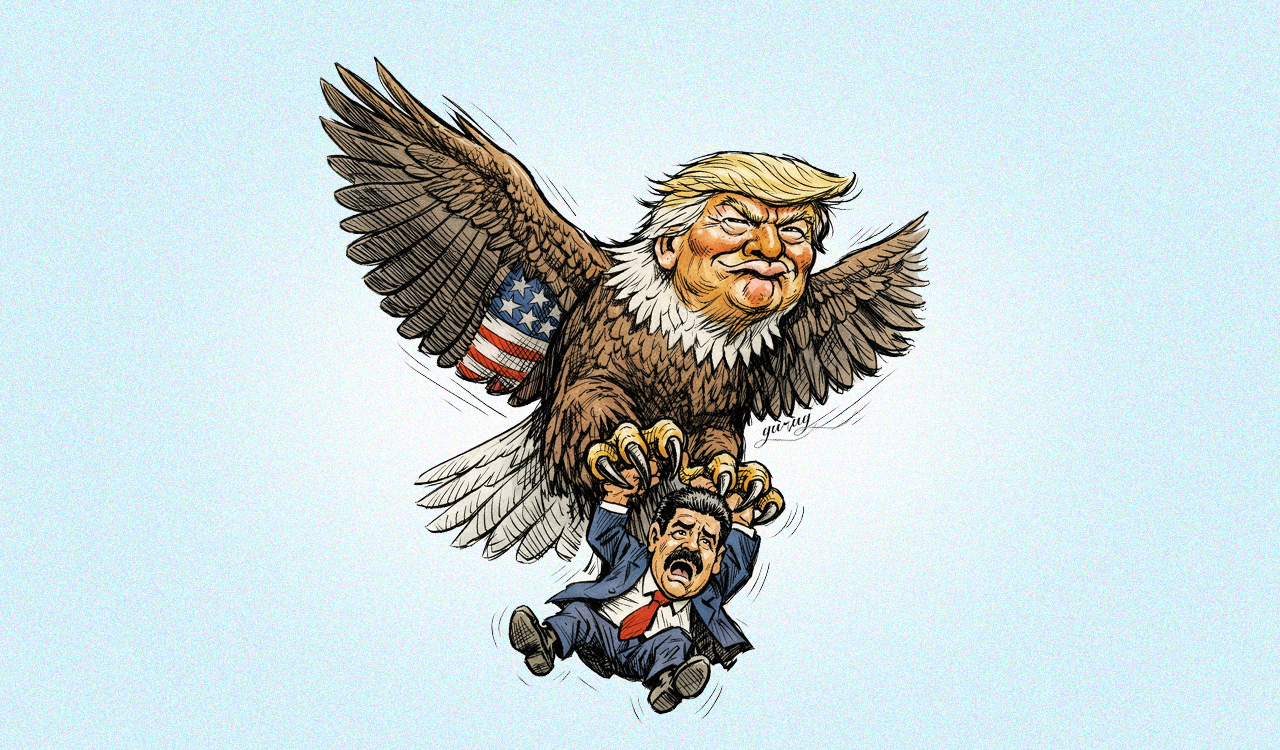
The US military operation in Venezuela culminating in the capture of President Nicolás Maduro constitutes a deeply unsettling rupture in contemporary international politics. Revived through the rhetoric of the Monroe Doctrine, the intervention reveals not a defensive impulse but a calculated assertion of dominance—one that has unsettled opinion even within the United States.
Also Read
Regardless of its official description, the episode represents a direct use of force against a sovereign state, compelling a reassessment of sovereignty, non-intervention, and the shifting contours of legitimacy in an increasingly unilateral world.
Regional Security Lens
Viewed through a regional security lens, Venezuela’s sustained economic collapse and democratic decay have undeniably spilled beyond its borders. Large-scale migration flows, the deepening of illicit markets, and the entrenchment of transnational criminal networks have generated material, social, and political pressures across Latin America, rendering international attention both predictable and, to a degree, warranted. These cross-border effects have strained state capacities, complicated regional governance, and intensified securitised responses to migration and crime, particularly in already fragile institutional contexts.
Yet concern, however justified, cannot be mistaken for authorisation. The presence of instability does not exempt external actors from the constraints of international law, nor does it absolve them of their obligation to respect sovereignty and non-intervention. To conflate regional disruption with a mandate for unilateral force is to erode the very norms that structure international order. Addressing Venezuela’s transnational repercussions requires collective, institutional, and rights-based engagement, rather than coercive measures that risk perpetuating instability while claiming to resolve it.
The United States decision to deploy military force and to prosecute a sitting head of state in the absence of an explicit multilateral mandate constitutes a direct and troubling challenge to the post-1945 legal and normative architecture of international order. The United Nations Charter deliberately circumscribes the use of force, permitting it only in narrowly defined circumstances of self-defence or through collective authorisation, precisely to prevent the arbitrariness of power from supplanting law.
Selective Adherence
By circumventing these constraints, the intervention risks hollowing out the very rules that are routinely invoked to regulate and discipline the conduct of weaker states. Such selective adherence corrodes normative consistency and undermines the credibility of international law itself. Sovereignty, in this context, cannot be treated as a conditional concession extended by dominant powers; it remains the foundational organising principle that sustains predictability, restraint, and a modicum of equality within an otherwise asymmetrical international system.
A durable response to Venezuela’s crisis lies not in theatrical coercion but in the slower labour of multilateralism — where dialogue, humanitarian responsibility, and institutional recovery restrain power and privilege order over domination
Equally troubling is the way criminal justice has been fused with regime-change logic. The framing of Maduro as a transnational criminal—particularly through the language of “narco-terrorism”—has facilitated a dangerous conceptual slippage between domestic law enforcement and interstate coercion. Such securitisation obscures deeper structural drivers of Venezuela’s crisis, including economic mismanagement, sanctions-induced distortions, and long-standing social inequalities.
More importantly, it normalises the idea that legal indictment can serve as a pretext for military intervention. If accepted as precedent, this logic could furnish powerful states with a flexible instrument to delegitimise and depose adversarial governments under the veneer of legality.
Historical memory in Latin America renders these developments especially resonant. The region’s experience with external intervention — often justified in the language of stability, order, or moral responsibility—has repeatedly produced outcomes antithetical to democratic consolidation and social peace. Contemporary invocations of hemispheric security and resource stabilisation echo earlier doctrines that conflated regional order with external tutelage. Unsurprisingly, the US operation has been met with widespread condemnation across the Global South, reinforcing perceptions of a selective and hierarchical international order.
Power-centred Politics
The aftermath of the intervention further underscores the fragility of coercive solutions. The sudden removal of an incumbent regime, absent a carefully negotiated and internationally supervised transition framework, risks deepening political fragmentation and social volatility. Power vacuums seldom yield democratic renewal by default; more often, they generate competing centres of authority, civilian insecurity, and long-term instability. The humanitarian costs of such disorder—borne disproportionately by ordinary citizens—rarely figure prominently in interventionist calculus.
What is at stake extends far beyond Venezuela. The episode erodes the normative barrier separating concern from coercion and diplomacy from enforcement, accelerating a drift toward power-centred politics in an already fatigued global order. Once sovereignty becomes negotiable, rule-governed restraint yields to discretionary force. A durable response to Venezuela’s crisis lies not in theatrical coercion but in the slower labour of multilateralism—where dialogue, humanitarian responsibility, and institutional recovery restrain power and privilege order over domination.
The Venezuelan intervention poses an unsettling test for the international community: whether norms sacrificed to expediency can coexist with claims to a stable and just global order. Sovereignty and non-intervention retain meaning only when upheld under pressure, for international legitimacy ultimately rests on such restraint.
(The author is Assistant Professor in Political Science, Department of Politics, Policy and Diplomacy Studies, School of Liberal Arts and Humanities, Woxsen University, Hyderabad)

Related News