Opinion: Writers, Reading, Freedom
History shows, the dissident word survives and even thrives because writing is about freedoms


By Pramod K Nayar
The poet Eliot, worrying about the right word, writes in The Four Quartets:
Also Read
Words strain,
Crack and sometimes break, under the burden,
Under the tension, slip, slide, perish,
Decay with imprecision, will not stay in place,
Will not stay still.
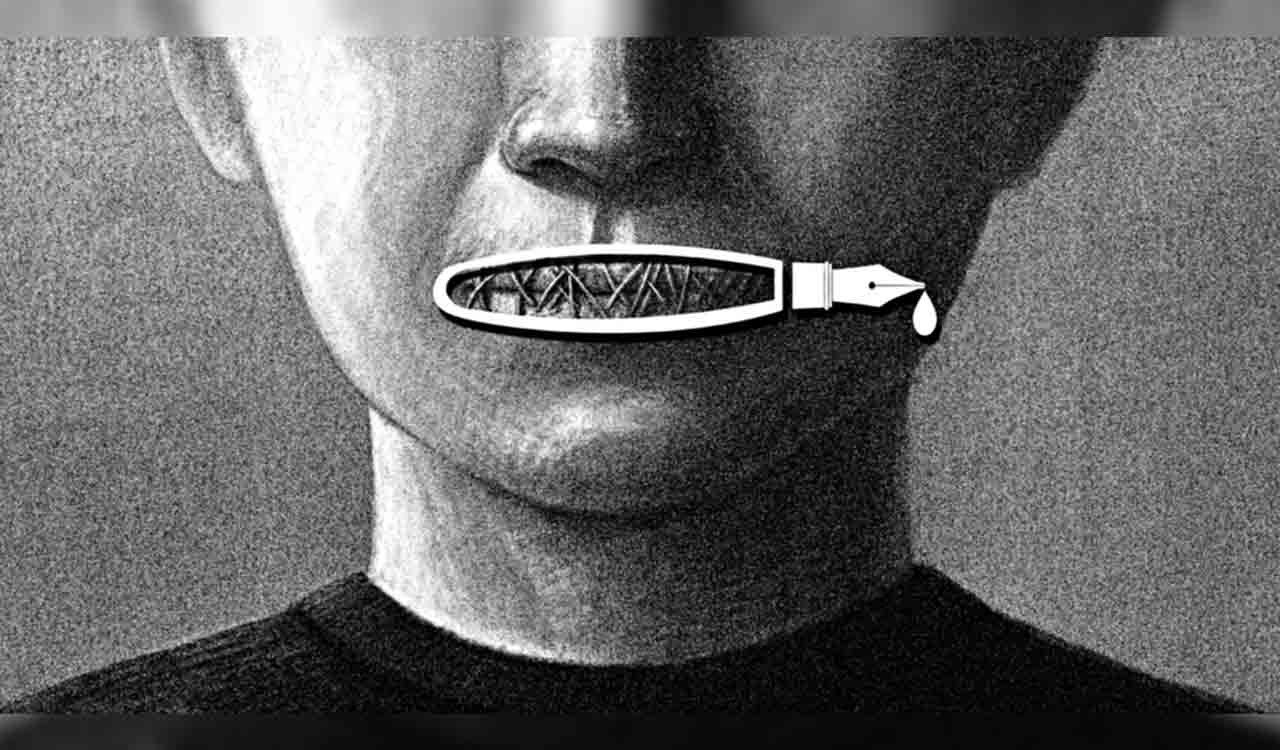
The strain of finding the right word to capture an intensity, a singularity or even the banal, haunts writers. In several cases, the words are under a strain because their speaking subject is under a strain, whether in the form of a fatwa, a state order banning public servants from writing opinion pieces, or non-state actors assassinating writers. And yet, history shows, the dissident word survives. Even thrives. Because writing is about freedoms.
Vulnerable Speaking Subjects
The attack on Salman Rushdie, coming decades after the fatwa, shook the literary world. Why the ‘mere materialization, on perishable parchment or paper, even stone, of some immutably determined word, evokes such mortal and primitive passions’, writes Nobel Laureate Wole Soyinka, needs to be investigated, not without a touch of irony.
Various literary critics claim that words and letters are nothing more than ‘discourses’ and operations of a pre-existing language that serve to maintain oppressive social hierarchies. All of these are true. And yet, the attack demonstrated a simple truth. The meaning, import and image of the words used in the ‘offensive’ text, evidence a life-and-blood consciousness: the speaking subject. The subject, SR, is the operating consciousness behind the word, no matter that he himself is the creation of discourses and power structures. This subject, literally, spilt ink and blood on paper and on stage.
The psychoanalytic critic Julia Kristeva says in her Oxford Amnesty Lecture of 1992, that it is the sounds, meaning and the process of meaning-making in ‘what we call “literature” that make of it the very place where the social code is destroyed and renewed’.
In other words, how poetic language — by which we also mean extended narratives such as novels — makes meaning are the modes by which the social code is questioned. And herein lies the rub.
The author’s authority in compiling words in a certain order so as to worry at the social code is a matter of anxiety because poetic language employed is always marked by heterogeneity, a meaning other than what the state wants or orders. Heterogeneity, writes Kristeva, ‘produces non-sensical effects, which destroy … accepted beliefs and meanings’. It is for this author-function that attacks are mounted, arrests ordered and lives erased: words reshape worlds, and no matter how much we argue — or ChatGPT sets out to prove — that language operates prior to us, there is a speaking subject who put her words, and her life, on the line when she strung them together.
Words and the Social Code
In a famous essay on Macbeth, the critic Terry Eagleton argued that the witches are the real ‘heroes’ of the play because they shape and reshape the existing social order. Extending this argument, André Brink, the South African novelist and anti-apartheid activist, categorised the writer as a ‘witch’. Tracing the etymology, Brink notes it comes from ‘wit’ (knowledge) and ‘weihen’ (to consecrate). Expanding the term’s connotations, Brink links it to ‘heresy’, which originally meant ‘choice’. Brink writes:
In our present context this [‘heretic’] would imply a choice against the power structures of the establishment in a given society; against the dominant discourse of the day; against the grain; sometimes even “against nature”
Writers, like witches, ‘embody…society’s forces of renewal and regeneration’. When the so-called oppositional voices — whether in teachers’ unions or public intellectuals — are afraid to call into question dangerous public or state policies (though at one time these screamed about ‘oppression’ and ‘social injustice’), the witches and their wit are gone. The price paid is the literary too because we cannot ‘underestimate what the word can do in the world’ (Brink). The literary word even in the age of darkness offers us something.
To return to Brink:
Each literary text is not just a leap of the imagination but an act of faith, in the widest sense of the word.
This is why writers become dangerous: they encourage us to an act of faith, to seek answers. The writer’s watchword, says Brink, is ‘ “Speak-demand-we will answer”, even if that answer may not be what we expected or what we should like to hear’. This possibility of hearing another meaning and another vision is sufficient reason to teach the literary as well.
Choice of Interpretations
Writers are threats, we now know. They take on the state, they take on decadents and they even take on, in Wole Soyinka’s biting descriptor, ‘the competitive custodians of ultimate truth, and the apologists of marshmallow cultural sensibilities’. They offer us not just possible selves but a society of such selves, a ‘chorus of not necessarily harmonious voices’, in the critic Wayne Booth’s terms.
Writing is linked to a freedom of choice of interpretations, whether of the text or of life itself. We take in new selves when we encounter others, especially others unlike us, and in the process discover that our lives are plot lines (I adapt here Booth again). The plot lines involve our family lines but also, crucially, the social world. That is, when we read, we discover the embedding of our singular life in a web of other such lives. This is why when an individual dies, some part of another dies too: because our plot lines are intertwined.
This is not to claim that writing is an exact replica of life, and that is why literature must be defended (does it, really?). Writing and the concomitant freedoms of expression and interpretation constitute us as individuals and as social selves because these freedoms make us subjects with choices. The freedom to interpret is the freedom of the self:
What is essential about [the] self is not found primarily in its differences from others but in its freedom to pursue a story line, a life plot, a drama carved out of all the possibilities every society provides: the amount of overlap with other story lines matters not a whit.
Literature is nothing else but a celebration of freedom.

Related News