Study decodes mystery around ‘black tigers’
New Delhi: Similipal tiger reserve in Odisha has a unique feature. It is the only tiger reserve in the world where a subspecies of tigers called Pseudomelanistic tigers have been photographed. Pseudomelanistic tigers stand out from the rest of the tigers as the black stripes on their back are so wide that they almost overlap […]
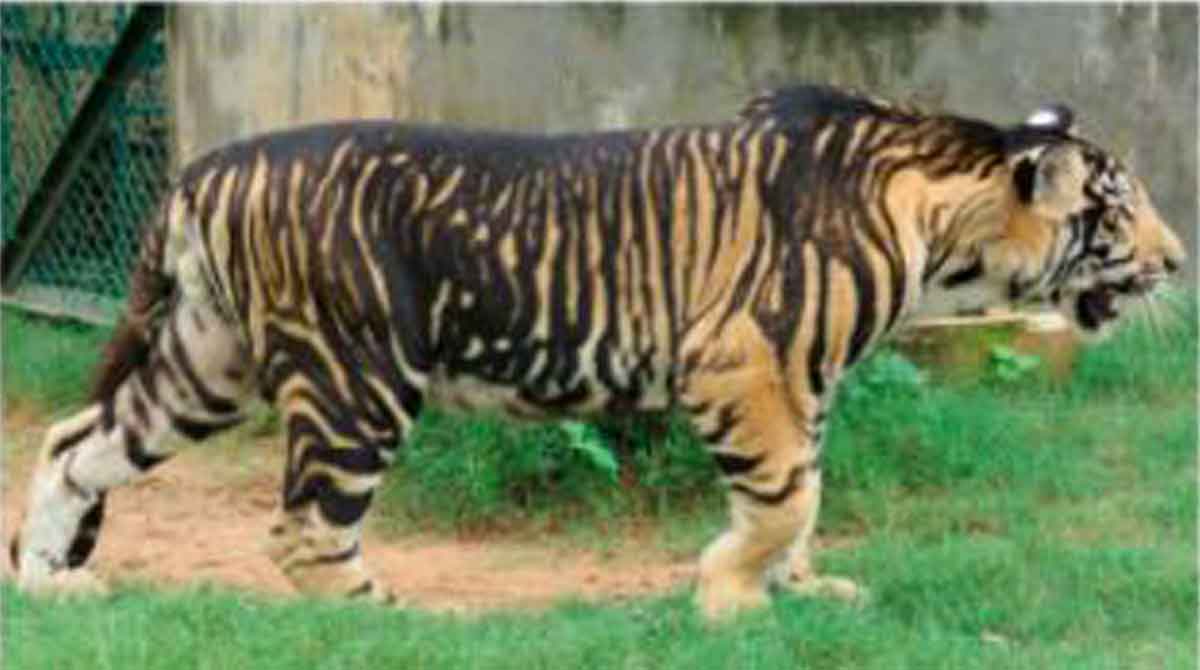


New Delhi: Similipal tiger reserve in Odisha has a unique feature. It is the only tiger reserve in the world where a subspecies of tigers called Pseudomelanistic tigers have been photographed. Pseudomelanistic tigers stand out from the rest of the tigers as the black stripes on their back are so wide that they almost overlap each other and seen from a distance the animals seem to be jet black.
The black tigers have been a matter of mystery. A number of questions remain unanswered about the animal such as what makes them the way they are? Is their presence unique to Similipal? Or are they present anywhere other than Similipal also but it is just that they haven’t been photographed outside of Similipal? A new study by a team of scientists drawn from several institutions both within and outside the country has now found some answers.
Such questions can be answered by studying the genetics of animals. But, conducting such studies is easier said than done particularly in the case of animals as elusive as tigers. One needs samples from well-identified individuals and obtaining samples from tigers in the wild with the confirmed identity of individuals is next to impossible.
A breakthrough came in 2014 when two pseudomelanistic tiger cubs were born in captivity at Nandankanan Biological Park in Bhubaneswar. The stroke of luck got strengthened when one year later one more pseudomelanistic cub was born to the same parents. A team of scientists from the National Centre for Biological Sciences (NCBS), Bengaluru, obtained samples from these captive tigers and analysed their DNA sequence.
They found that mutations in a gene called Taqpep were responsible for the different patterns of stripes in pseudomelanistic tigers. All pseudomelanistic tigers had a mutation in both copies of their Taqpep gene that they received from their mother and their father. Normal-looking tigers either did not have that mutation at all, or they had it on only one copy of the gene.
The researchers then collected non-invasive samples of wild tigers in the form of faecal urine, matter and saliva from animals hunted and partially eaten by tigers from Similipal and several other forest areas across India and found that the mutation was present only in Similipal tigers, nowhere else. Clearly, there was something going on in Similipal.
They then compared the genetic data of tigers collected from Central India, South India, and North-West India with that of tigers from Similipal. They observed that Similipal tigers were more related to each other than tigers from Central India or South India. This indicated that Similipal tigers were more inbred. Also, Similipal tigers were genetically different from other central Indian tigers. Both these aspects pointed towards the genetic isolation of Similipal.
The scientists have concluded that the high frequency of the pseudomelanistic variant within Similipal could be because of a process called genetic drift. Genetic drift is an evolutionary force that can bring changes in the frequency of genetic variants within a population just by chance. Like tossing a coin once might result in a head or a tail just by chance, genetic drift can change the frequency of one genetic variant over another just by chance. Genetic drift works in all the natural populations but has stronger effects in small and isolated populations. As evidence suggested Similipal to be a small and isolated population, genetic drift seemed to explain the observations.
The study team has published a report on their work in Proceedings of the National Academy of Sciences (PNAS).

Related News
-

Telangana farmers, farm labourers return to migration amid water shortages, crop losses
-
Two held with 142.8 kg of ganja worth Rs 71.40 lakh in Sangareddy
-
Odisha to hold college, university student polls on October 15
-
Odisha awaits Central Zoo Authority’s permission to keep rescued Orangutans at Nandankanan