This strange exoplanet behaves like ‘Planet Nine’
The exoplanet called "HD106906 b" occupies an unlikely orbit around a double star 336 light-years away, according to the study published in the Astronomical Journal.
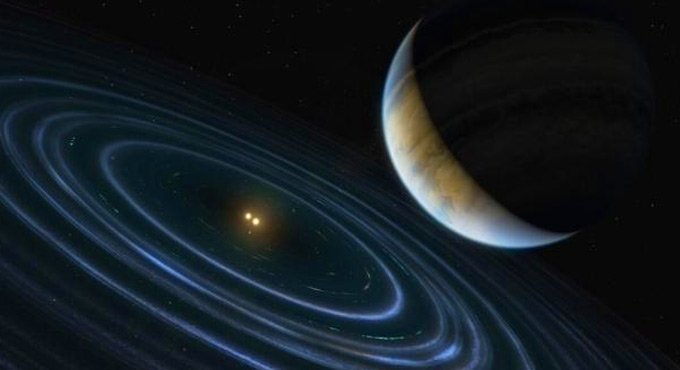


Washington: NASA and European Space Agency’s Hubble Space Telescope has helped astronomers identify a strange planet outside our solar system that behaves like the long-sought “Planet Nine”.
The exoplanet called “HD106906 b” occupies an unlikely orbit around a double star 336 light-years away, according to the study published in the Astronomical Journal.
This is the first time that astronomers have been able to measure the motion of a massive Jupiter-like planet that is orbiting very far away from its host stars and visible debris disc.
The exoplanet HD106906 b was discovered in 2013 with the Magellan Telescopes at the Las Campanas Observatory in Chile’s Atacama Desert.
However, astronomers did not then know anything about the planet’s orbit.
This required the help of Hubble Space Telescope to collect very accurate measurements of the vagabond’s motion over 14 years with extraordinary precision.
The exoplanet resides extremely far from its host pair of bright, young stars — more than 730 times the distance of the Earth from the Sun.
This wide separation made it enormously challenging to determine the 15,000-year-long orbit in such a short time span of Hubble observations.
The Hubble team behind this new result was surprised to find that the remote world has an extreme orbit that is very inclined, elongated and external to a dusty debris disc that surrounds the exoplanet’s twin host stars.
The debris disc itself is very extraordinary, perhaps due to the gravitational tug of the rogue planet.
“To highlight why this is weird, we can just look at our own solar system and see that all of the planets lie roughly in the same plane,” said lead researcher Meiji Nguyen of the University of California, Berkeley.
“It would be bizarre if, say, Jupiter just happened to be inclined 30 degrees relative to the plane that every other planet orbits in. This raises all sorts of questions about how HD 106906 b ended up so far out on such an inclined orbit.”
The prevailing theory to explain how the exoplanet arrived at such a distant and strangely inclined orbit is that it formed much closer to its stars, about three times the distance that Earth is from the Sun.
However, drag within the system’s gas disc caused the planet’s orbit to decay, forcing it to migrate inward toward its stellar hosts.
The gravitational forces from the whirling twin stars then kicked it out onto an eccentric orbit that almost threw it out of the system and into the void of interstellar space. Then a star passed very close by to this system, stabilising the exoplanet’s orbit and preventing it from leaving its home system.
This scenario to explain HD106906 b’s bizarre orbit is similar in some ways to what may have caused the hypothetical Planet Nine to end up in the outer reaches of our own Solar System, beyond the Kuiper Belt.
To date, astronomers have only circumstantial evidence for the existence of Planet Nine.
They have found a cluster of small celestial bodies beyond Neptune that move in unusual orbits compared to the rest of the Solar System.
This configuration, some astronomers think, suggests that these objects were shepherded together by the gravitational pull of a huge, unseen planet.
An alternative hypothesis is that there is not one giant perturber, but instead the imbalance is due to the combined gravitational influence of much smaller objects.

Related News