Using AI to predict heart episodes
Hyderabad: Artificial Intelligence (AI), Machine Learning (ML), Deep Learning (DL), Algorithms, and large amounts of data sets are the present-day buzzwords that are being increasingly used in all walks of life to predict outcomes. Worldwide, software researchers and technology leaders are virtually in a race to collaborate with super-specialty doctors to unlock the potential of […]


Hyderabad: Artificial Intelligence (AI), Machine Learning (ML), Deep Learning (DL), Algorithms, and large amounts of data sets are the present-day buzzwords that are being increasingly used in all walks of life to predict outcomes.
Worldwide, software researchers and technology leaders are virtually in a race to collaborate with super-specialty doctors to unlock the potential of AI and predict a relatively healthy individual’s health risk in the future.
The idea is to utilise the past data, which is available in the form of electronic medical records of patients, and teach the AI-based computer systems through algorithms, to analyse permutations and combinations, and forecast the risk of healthy individuals falling sick with ailments.
In the foreseeable future, a day might come when AI-based systems will be able to accurately predict the exact disease a healthy individual might face in the next decade. While a lot more research in this field is yet to be taken up, a ground-breaking AI-based cardiac risk predicting system has been developed by software professionals from Microsoft and senior cardiologists from Hyderabad.
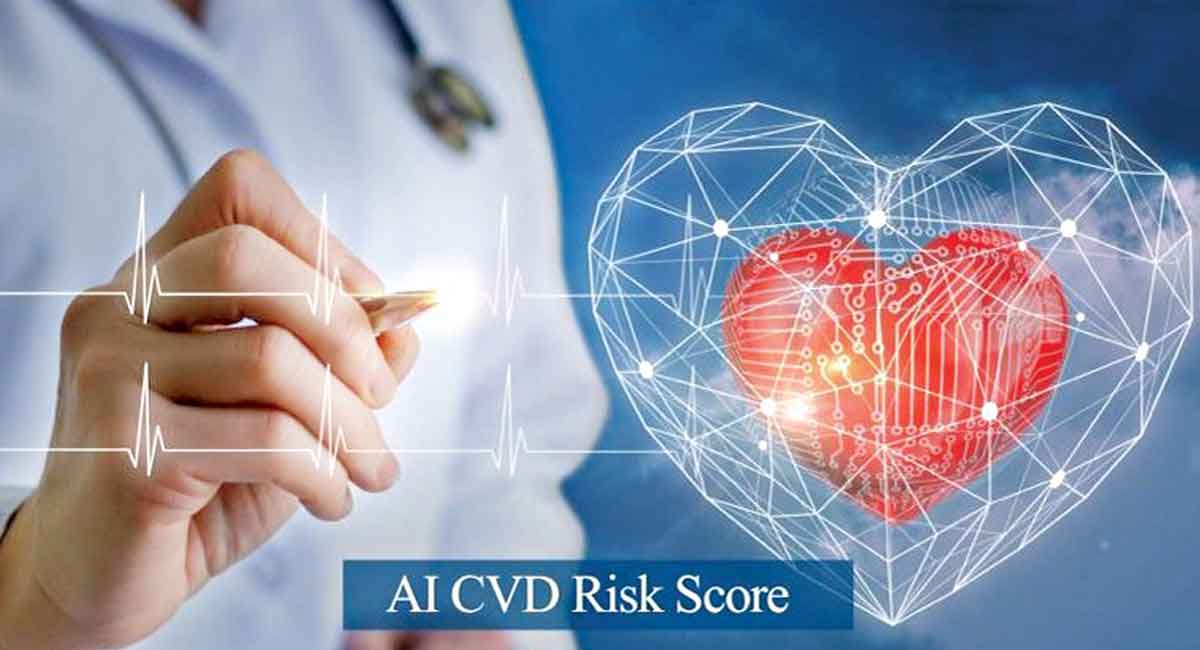
Yes, there is an AI-based computer system in Hyderabad that can, with a simple routine health check-up, predicts the risk of an individual from experiencing a heart episode, in the next 10 years. Dubbed as Cardiac Risk Score Calculation, the AI-based system is under implementation for the past 6 to 8 months across multiple facilities of Apollo Hospitals in Hyderabad and other major Indian cities.
“By utilising AI, Machine Learning, Deep Learning and Algorithms, we have developed a cardiac risk score, which tells the probability of getting a heart attack in the next ten years for individuals anybody between 18 years and 80 years. The accuracy of our AI-based cardiac risk score is between 89 per cent and 92 per cent,” says Head, Cardiology, Apollo Hospitals, Secunderabad, Dr J Shiv Kumar. It’s not easy for cutting-edge software developers from Microsoft Global and super-specialist cardiologists to come together, speak in a common language and develop an AI-based system.
“We are basically speciality doctors and Microsoft engineers were hardcore AI algorithm coders and technology thinkers. It took a year for both of us to understand each other’s thought processes and requirements. We started working together in 2017 and developed the AI risk score in 36-months,” says Dr Shiv Kumar.
The AI-based software, which is expected to get published in a globally recognised peer-review journal in the coming months, was also validated among 12,000 patients in the Netherlands.
So what started all this?
The Microsoft-powered Ai-based risk score is not the first cardiac risk score that is available. In fact, there is a globally-recognised Framingham Risk Score (FRS) risk assessment tool, which is widely recommended for coronary risk assessment.
However, there are some difficulties with such models. Existing risk assessment tools are regression models, which means they don’t leverage the potential of AI in assessing the risk of a patient. They take into account 6 to 12 risk factors while developing the risk score. Risk assessment tools developed by western countries are meant for local population and not for Indians.
“These risk scores were never tried in our local population and as a result, they always either underestimated or overestimated the risk. In Randomised Control Trials (RCTs), most of these existing models had an accuracy of 40 per cent to 45 per cent, which is the biggest flaw in such regression models,” Dr Shiv Kumar said.
Usually, to develop a risk score, group of super-specialist doctors come together and identify risk factors and recommend them, which are then used to develop the risk score.
“We did not want to select risk factors because there could be so many other relevant things that could be risk factors, which we are not aware of. That’s why, allowing AI-based systems to develop risk factors on its own was important,” he says.
Health data of 34,000 to 36,000 individuals, who underwent routine medical health check-ups at various branches of Apollo Hospitals in the country were utilised for the AI-based systems, which eventually identified 21 risk factors and based on that developed the cardiac risk score.
Now you can get handpicked stories from Telangana Today on Telegram everyday. Click the link to subscribe.
Click to follow Telangana Today Facebook page and Twitter .

Related News