Book Review: ‘India’s Relations With The International Monetary Fund’
Author: V. Srinivas Publishers: Vij Books India Pvt Ltd, New Delhi (India) & Indian Council of World Affairs, Sapru House, New Delhi (2015). V. Srinivas, a career civil servant, distinguishes himself as a pragmatic researcher in this excellent research output of over fifteen months. Authenticity of this publication arises from his participation in Annual Fund-Bank […]
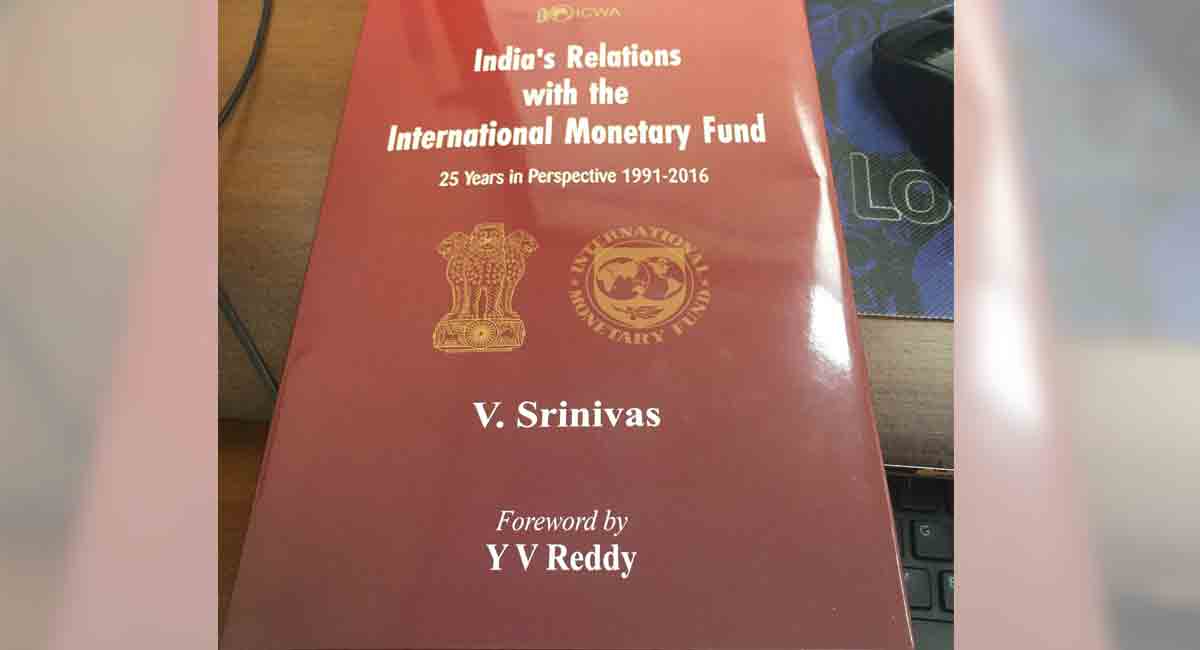


Author: V. Srinivas
Publishers: Vij Books India Pvt Ltd, New Delhi (India) & Indian Council of World Affairs, Sapru House, New Delhi (2015).
V. Srinivas, a career civil servant, distinguishes himself as a pragmatic researcher in this excellent research output of over fifteen months. Authenticity of this publication arises from his participation in Annual Fund-Bank Meetings when he was private secretary to the Union Finance Ministers and an average seventeen IMF Board meetings every month for a period of 3 years from 2003-06. Dr. Y.V. Reddy’s (former Governor, RBI), Foreword adds great value to this book.
Not much literature outside the IMF website is available and that makes this book a useful contribution from a third angle.
This book is divided into 13 chapters that can be broken into four parts for convenience: IMF and its role in global financial stability; India’s interface with IMF; The role played by the Minsters of Finance, Finance Secretaries to Government, Chief Economic Advisors, Executive Directors of IMF, and Governors of RBI; Author’s own experience with the IMF and the period beyond G-20 to the present.
Most Indians recall with recalcitrance, if not contempt, the conditionalities imposed by the IMF when India had to resort to borrowing when its forex resources dwindled to just fifteen days of imports in 1990.
It is only when one reads this book by V. Srinivas, a career civil servant, now Secretary to Government of India, Department of Administrative Reforms and Public Grievances and Department of Pensions and Pensioners Welfare, Government of India, the reader gets a glimpse of global economic history of the last twenty-five years with shifts from uni-polarism to bipolarism to multilateralism and the rationale behind the conditionalities it generally imposes on its borrowers.
An economic historian is concerned less to appraise the validity of an idea than to understand its development. But this historian, travelling through the 25 years of the IMF journey, appreciates and understands the development as well. Since this book is an outcome of his personal experience, the most significant are truisms.
The author vividly describes the reason for the existence of IMF, how it has accomplished its objectives, its changes over time, albeit, within its own limitations and the ethos of an economic system. He did not profess to offer a complete interpretation of the events that led to various decisions of the Fund.
The book gives the impression that the author observed tremendous restraint while giving an account of the way the Fund treated different nations differently even in similar circumstances.
The book deals with the most important crises periods of Asia, Europe, and the rest of the world that IMF intervened to resolve: International Debt Crisis (1982-89), The East Asian Crisis (1997), The Russian Economy Crisis (Economic perestroika), the great recession (2008), The European Crises (2010).
The author describes the dynamics of the decision to devalue the Indian Rupee when P.C. Bhattacharya, the then Governor, RBI reluctantly agreed to making Indian Rupee to a new par of Rs.7.50 per US Dollar. He is of the opinion that we would have done better by going to the IMF in 1989 itself instead of 1991 when our chips were completely down.
The author could have done greater justice to the chapter had he commented on the equity principle that was set aside in 1985-86 Budget itself.
In the third part of the book, he described his experience with the Finance Ministers, notably, Yashwant Sinha, Manmohan Singh, Pranab Mukherjee, Chidambaram and Arun Jaitley and the way they interacted with the Fund with high sense of accommodation, alacrity, and national compulsions to revive and reform for a formidable growth.
“The serious issues relating to IMF, according to the author are a) the governance of IMF and associated ideological biases; b) its asymmetric treatment of countries in its surveillance; c) differentiated conditionality prescribed as between borrowing countries; d) its failure in recognizing the contribution of borrowers; e) its incapacity to resolve sovereign debt restructuring issues; and finally f) developing a system to replace U.S. Dollar as a de facto global currency since 1970s.”
The author’s description of his own experience with the IMF would guide many a civil servant who aspire to make a career in finance.
This book is a must-read for all the students and researchers of economics, policy makers and decision-makers in the areas of economy and finance.
By B. Yerram Raju
Now you can get handpicked stories from Telangana Today on Telegram everyday. Click the link to subscribe.
Click to follow Telangana Today Facebook page and Twitter .

Related News