Editorial: Game changer mission
XPoSat marks a major milestone in ISRO’s journey from being an agency tasked with placing satellites in orbit to a research organisation
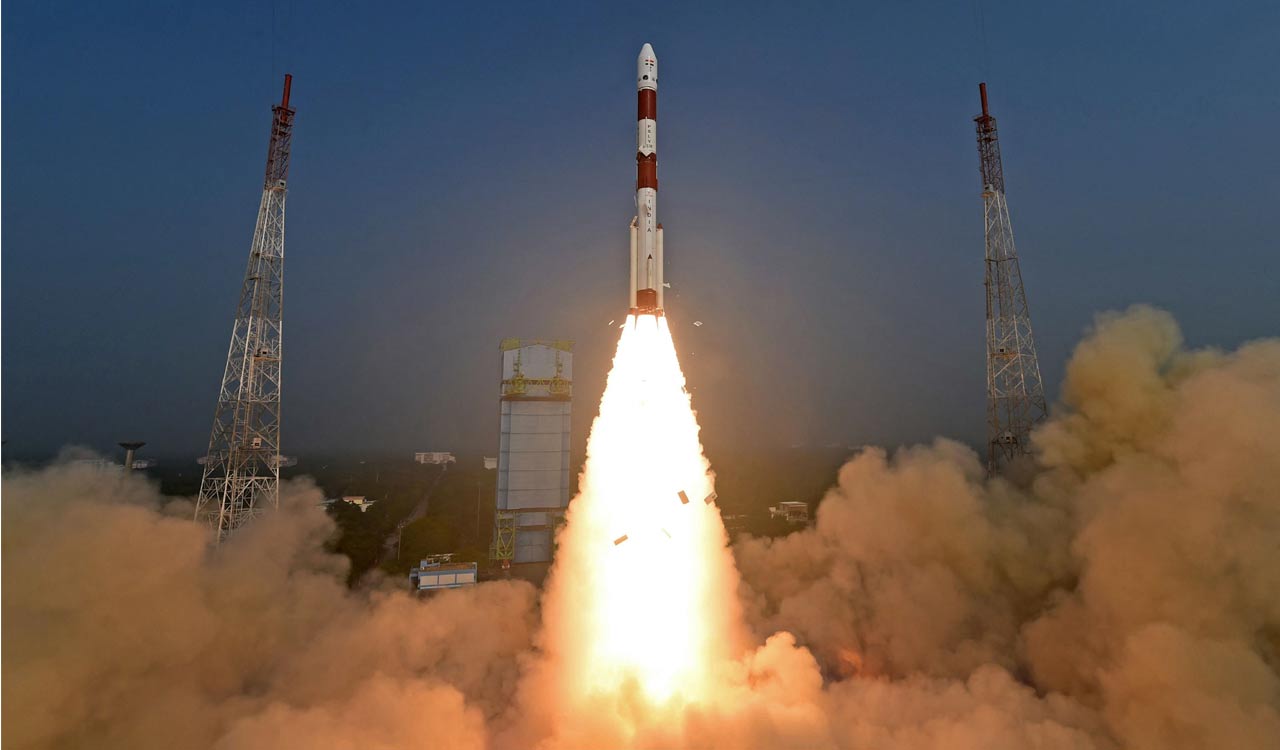


The new year began with a bang for the Indian space research community with the successful launch of the X-ray Polarimeter Satellite (XPoSat), a unique mission to study X-ray polarisation and its cosmic sources such as black holes and neutron stars. This is India’s maiden endeavour — a game changer — to analyse the polarisation of X-rays emanating from bright celestial sources in the medium frequency band. XPoSat comprises two payloads, including X-ray Polarimeter (POLIX) and X-ray Spectroscopy and Timing (XSPECT). They have been built by Raman Research Institute and UR Rao Satellite Centre, both located in Bengaluru. It is the world’s second such mission after the Imaging X-ray Polarimetry Explorer (IXPE) launched by NASA in 2021. What is more fascinating about the endeavour is that it can unravel the universe’s deepest secrets and mysteries surrounding black holes and neutron stars. Because of their immensely strong magnetic fields, some of these celestial bodies emit highly energetic X-ray light. These cosmic rays are absorbed by the Earth’s atmosphere. Scientists, therefore, need X-ray telescopes in space to understand them. XpoSat has two such payloads which could help scientists scout for emissions from black holes, neutron stars and active galactic nuclei. Since the 1970s, imaging studies and spectroscopy have given scientists a fair idea of the energy, time and location of celestial X-rays. The introduction of polarimetry observations by IXPE marked the beginning of the endeavour to capture the degree and angle of light. Now, the Indian mission will complement NASA’s device and the information gathered by these two instruments together will help astronomers decipher the nature of pulsars and black holes.
The latest mission marks a major milestone in ISRO’s journey from being an agency tasked with placing satellites in orbit to a high-profile research organisation engaged in planetary exploration. The successful launch of Chandrayaan-3 and Aditya-I in 2023 cemented India’s reputation as a leader in space exploration. Besides the lunar and solar missions, ISRO executed several other important projects, including the testing of the technology demonstrator of Reusable Launch Vehicle (RLV-TD); the launch of the first in the second-generation navigation satellite series; and the testing of the crew escape module for the human space mission, Gaganyaan. Later this year, ISRO is set to join hands with NASA to send a mission to the International Space Station (ISS), the permanent laboratory in space about 400 km above the earth’s surface. A test flight of the Gaganyaan, without astronauts, is also scheduled for this year. With every venture, ISRO has sent signals that it has the expertise and maturity to contribute to all aspects of planetary research. India has already established a reputation as a dependable player in the commercial satellite market. It has been focusing its efforts on increasing its share of the global commercial space market. The Indian space industry’s major advantage is its cost-effectiveness.
Also Read

Related News
-

Editorial: Diluting institutional autonomy may boomerang
-
Incredible to watch capability ISRO is developing in science missions: Indian-American NASA senior official
-
India, France step up space cooperation with new private-sector deals
-
ISRO says remains at centre of India’s space programme, refutes media reports as ‘baseless’