Health and Tech: Life after organ transplant
In terms of leading an uninhibited lifestyle, organ transplantations don't provide a carte-blanche to recipients, as donated organs come with expiry date



Organ transplantation is a transformational experience, as patients who undergo this complex surgery are amongst the lucky few in India to have access to financial resources and a donor organ (could be cadaver or living related). Post-organ transplantation, however, recipients are quite unprepared to grapple with questions of morality, as they suddenly face the burden and perhaps even a sense of responsibility towards protecting the donor organ, which till recently enabled another human being to survive. In terms of leading an uninhibited lifestyle, organ transplantations don’t provide a carte-blanche to recipients, as the donated organs come with an expiry date.
There is no denying that organ transplantation bestows individuals, who till then had a few months left on this planet, with precious few more years to live. The fact also remains that the quality of life experienced by such patients, post-transplant is shrouded and least discussed. Due to heightened focus on organ donation by State governments, voluntary organisations and health care providers, there is a lot of awareness on pledging and donating of organs. In stark contrast, hardly anybody, including transplant experts, talk about the inherent risks of post-transplantation.
Post transplant surgery
The moment a patient receives a donor organ, his or her body’s immune response starts treating it as a ‘foreign’ object and reacts accordingly. Irrespective of whether the patient has received a heart, kidneys, liver or lungs, the body does not accept the donor organ and treats it as an outsider. As a result, the body immunity goes into an overdrive, which if left unaddressed leads to organ rejection.
Immediately after transplant surgery, the recipient is put on a dose of heavy and powerful combination of immunosuppressant drugs that comprise of steroids, calcineurine inhibitors and antimetabolites. While organ recipients are administered with this powerful cocktail of medicines (throughout their lifetime) to suppress immunity so that the body accepts donor organs, these drugs also carry the risk of causing secondary diseases like diabetes, hypertension, heart and kidney diseases and serious infections like lupus.
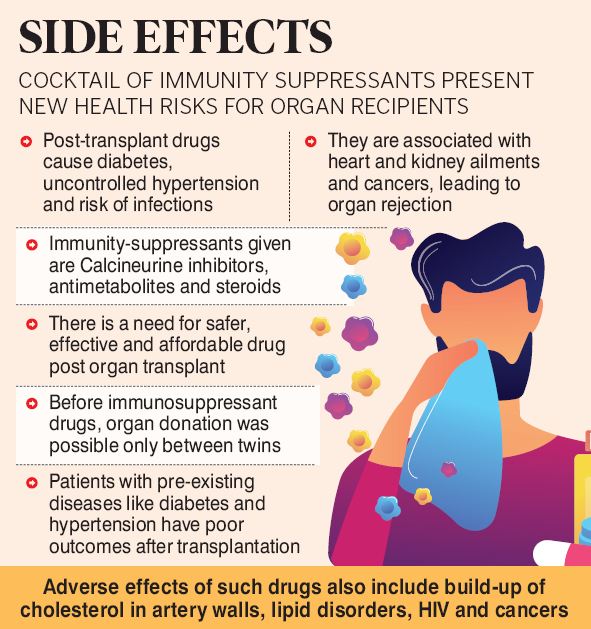
As a result of these complications, transplantation experts can’t give a guarantee that the regimen of expensive medicines, which have to be taken at least once or twice a day, will be effective and work well over long period of time and protect patient’s from body’s own immunity.
There are numerous well-documented studies that have indicated heart ailments are the most common cause of death among patients who have received a donor organ. The side effects of such drugs that reduce body immunity also include cancers, a major reason why life expectancy of transplant patients falls short of a typical healthy individual.
As the number of organ transplants not only in Telangana but across the country rises, there is also a definite rise in demand for a new class of highly effective drugs that can strike a balance between suppressing the body immunity, prevent secondary infections and add some quality of life for organ-recipients.

Related News
-

Harmanpreet Kaur, Deepti Sharma centuries power India to ODI series win over Zimbabwe
-
India’s men and women win at Commonwealth Kabaddi Championship 2026
-
Pratika Rawal’s century, Shafali Verma’s 64 power India to win over Zimbabwe
-
India’s women and men win opening matches at Commonwealth Kabaddi Championship