Hyderabad scientists discover ‘metabolic short circuit’ to stop deadly fungal infections
Scientists at Hyderabad’s CCMB have discovered that fungal infections may be stopped by targeting the sugar metabolism that fuels invasive growth. The study on Candida albicans offers new possibilities for developing more effective antifungal therapies.



Hyderabad: Genetic scientists from Hyderabad have uncovered a striking new insight into how fungi, which cause numerous fungal infections among humans, become dangerous and how we might be able to stop them.
Geneticists at the laboratory of Dr Sriram Varahan from Hyderabad-based Centre for Cellular and Molecular Biology (CCMB), in their latest breakthrough study, have proposed that to stop fungal infections, we may need to cut-off the energy and nutrients that enable them (fungi) to transform into harmful forms.
The study, which has the potential to pave the way for development of new anti-fungal treatment strategies, is focussed on targeting the metabolism of fungi and developing more effective antifungal therapies.
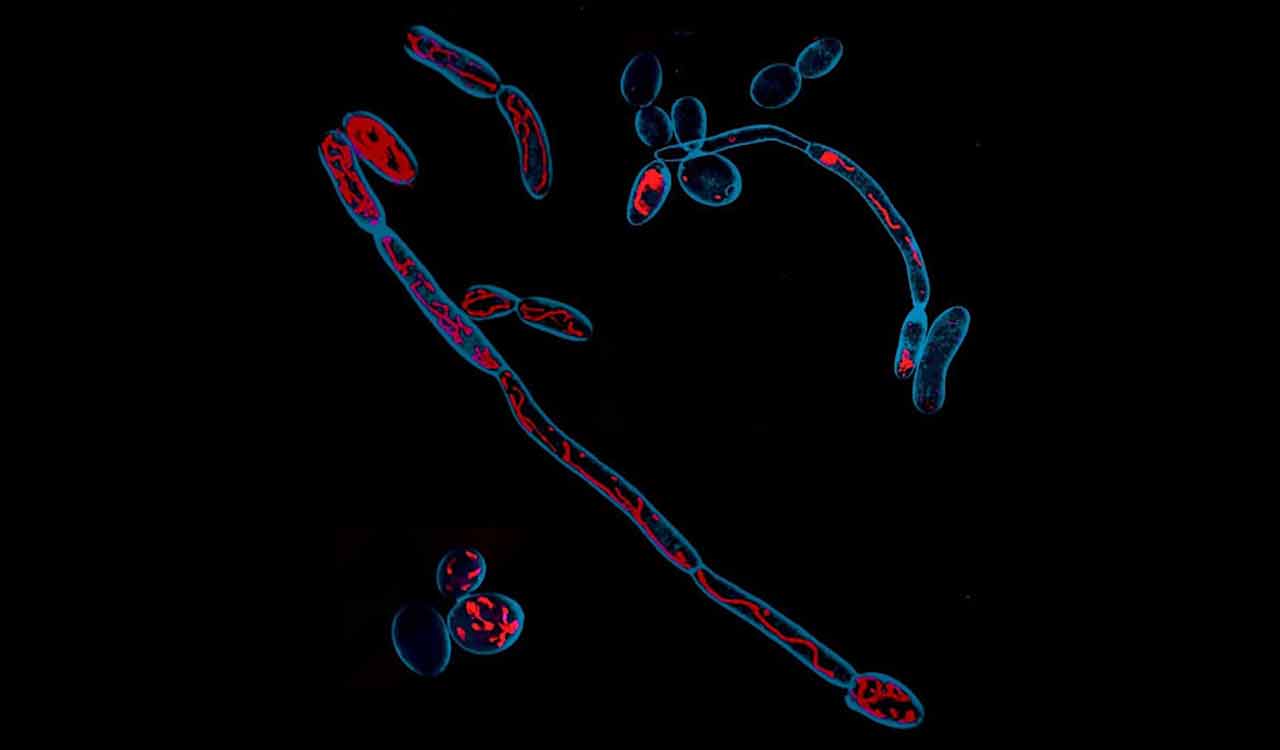
The CCMB study, which was carried out on a strain of Candida albicans (a leading cause of fungal diseases worldwide), has found that fungi’s sugar metabolism controls its ability to infect organisms.
“By looking at fungi through a metabolic lens, we uncovered what can be described as a previously hidden biological ‘short circuit’. We discovered a crucial connection between the process by which cells break down sugar to generate energy (called glycolysis) and the production of specific sulfur-containing amino acids,” said Dr Varahan.
Put simply, when fungi consume sugars rapidly, sugar breakdown also runs at high rates. This influences whether the cell can produce certain sulfur-based amino acids that are necessary for triggering invasive growth.
Thus, fungal shape-shifting is not only programmed by genes, it is also fuelled and controlled by how the fungi process nutrients, the researchers in a press release on Saturday said.
During the course of their studies, the researchers observed that Candida albicans showed a weakened ability to undergo morphogenesis, which is the biological process that causes fungi to develop its shape, as well as it also struggled to survive attacks from immune cells called ‘macrophages’.

Related News
-

Hyderabad: Woman allegedly sexually assaulted after offer of domestic work
-
KTR congratulates Kaiteki Innovations founder on Vande Bharatam award
-
Hyderabad: 151 officer trainees complete first phase of IPS training
-
A mirror in space to turn night into day? Hyderabad-based Skyroot deal brings sci-fi closer to reality