New method for detecting adulterants in milk
New Delhi: Researchers at the Bengaluru-based Indian Institute of Science (IISc)have developed a low-cost and effective method to detect adulterants in milk, by merelyanalysing the deposition patterns after evaporation. The team used the method to test forthe presence of urea and water, the most common adulterants, and suggest that thetechnique can be extended to other […]


New Delhi: Researchers at the Bengaluru-based Indian Institute of Science (IISc)
have developed a low-cost and effective method to detect adulterants in milk, by merely
analysing the deposition patterns after evaporation. The team used the method to test for
the presence of urea and water, the most common adulterants, and suggest that the
technique can be extended to other adulterants also.
Adulteration of milk is a pressing concern in developing countries like India, where a
significant portion of supplied milk fails to comply with the standards set by the Food Safety and Standards Authority of India. Water is frequently added to increase the volume of milk, along with urea, which makes the watered-down version whiter and foamier – this can potentially endanger the normal functioning of the liver, heart, and kidneys.
In their study, the researchers looked at evaporative deposition patterns – those that
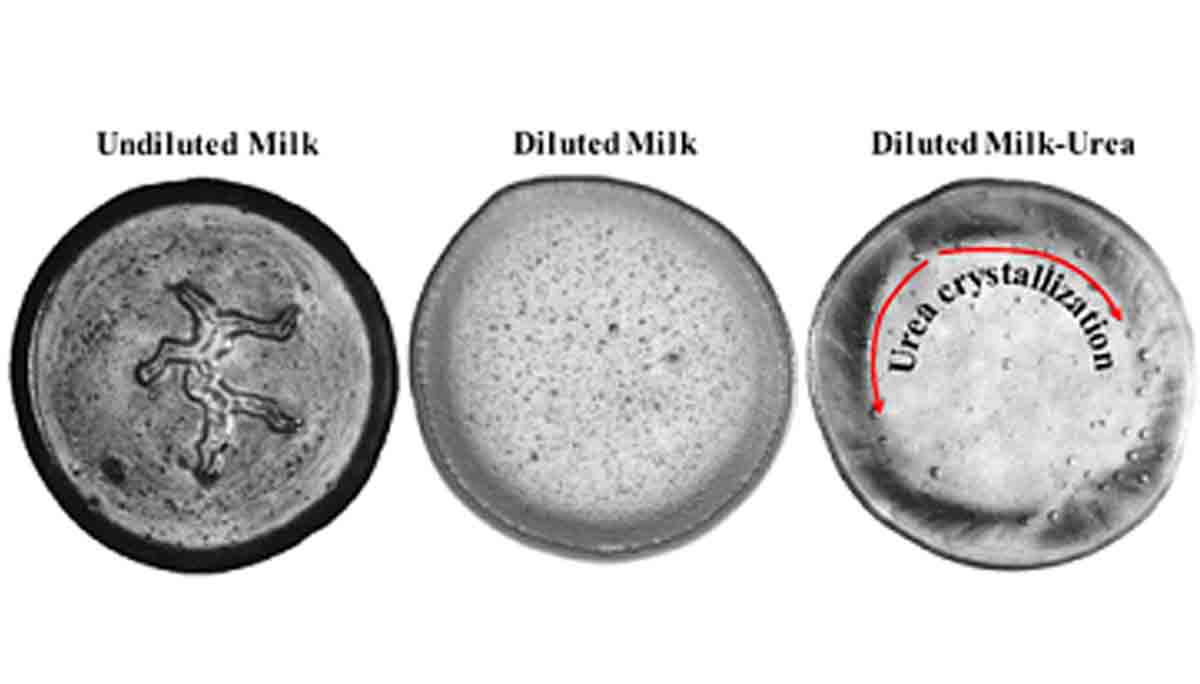
emerge when a liquid mixture like milk completely evaporates, causing volatile components to dissipate and solids or non-volatile components to arrange themselves in distinctive patterns. Milk with and without water or urea showed very different evaporative patterns.
In unadulterated milk, the evaporative pattern consisted of a central, irregular blob-like
pattern. Water was found to cause distortion or complete loss of this distinctive pattern,
depending on how much of it is added. Urea also completely erases the central pattern.
Being a non-volatile substance, it does not evaporate but instead crystallises, starting at the interior of the milk drop and extending along the periphery.
Current techniques such as lactometers look for changes in the freezing point of milk to
detect the presence of water, but they have certain limitations. For instance, the freezing
point technique can detect water only up to 3.5% of the total milk concentration. In
addition, although biosensors with high sensitivity are available to test for urea, they are
expensive, and their accuracy tends to decrease with time. The IISc team, on the other
hand, was able to detect water concentrations as high as 30% and urea concentrations in
diluted milk as low as 0.4% using pattern analysis.
The technique was designed by Dr. Virkeshwar Kumar, a postdoctoral researcher, and
Susmita Dash, Assistant Professor in the Department of Mechanical Engineering at the
Institute. They have published a report on their work in the journal ACS Omega.
The test does not require a laboratory or any other specialised process. “It can be done in
any place. It can be easily adapted for use even in remote areas and rural places,” said Dr Kumar.
He and Dr. Dash believe that this technique can potentially be extended to test for
adulterants in other beverages and products too. “The pattern that you get is highly
sensitive to what is added to it. So, I think this method can be used to detect impurities in volatile liquids. It will be interesting to take this method forward for products such as honey, which is often adulterated”, Dr. Dash said.
They noted that the simplicity of this method may also lend itself to easy automation, once the patterns for adulterants and their combinations are standardised. These could be fed into image analysis software, for example, which would compare a photo – even one taken with a mobile phone – of the sample’s evaporative pattern with other standard patterns to accurately detect the adulterants present.
“The next step that we are looking at is to test for adulterants, such as oil and detergents
that form an emulsion resembling milk. We plan to continue work in this direction, creating a repository of patterns corresponding to various concentrations of different adulterants,” Dr Dash said.
Now you can get handpicked stories from Telangana Today on Telegram everyday. Click the link to subscribe.
Click to follow Telangana Today Facebook page and Twitter .

Related News