Opinion: What is China really aiming for?
There are enough hints that Beijing is keeping its powder dry in both fronts of northeastern Himalayas.


By Amitava Mukherjee
Hyderabad: The latest Chinese postures in the Tawang sector of the Line of Actual Control (LAC) is a threatening spectre for the whole of northeastern India. Some commentators are proffering three reasons for this attempted Chinese push.
First is Beijing’s intention to discredit India after the latter became the Chairman of the G-20 conglomeration of countries and is conducting preparations for holding the group’s next summit meeting. The second is Beijing’s veiled message to India to drop its claim to Aksai Chin in lieu of undisturbed control over Arunachal Pradesh. The third is an open threat to India asking New Delhi not to become any part of the US-led axis in South Asia and the Asia-Pacific.
History Revisiting?
Whatever may be the actual reason, the security threat to northeastern India is real. There is some kind of geostrategic similarities between what happened in 1962 and what may happen in the present situation. A journey into history will show that 60 years ago China had, quite erroneously, accused Jawaharlal Nehru and the Government of India of playing a proxy game on behalf of the United States and the western capitalist bloc.
On the other side, certain pronouncements and actions by the Indian government did not help. JK Galbraith, the US ambassador to India, was certainly found to be interfering in India’s internal matters. Moreover, New Delhi could have distanced itself from Dalai Lama in spite of giving him shelter. In the present scenario, Beijing has taken almost a similar line over India’s role in the Asia-Pacific, particularly New Delhi’s participation in the QUAD (an informal strategic forum comprising the US, Australia, India, and Japan).
Imperialist Mentality
But that does not give China any right to do what it did in Ladakh or what it is trying to do in Arunachal Pradesh. In the western sector of the LAC, the Chinese road connecting Xinjiang and Tibet through Aksai Chin is now almost a fait accompli. So the reason behind Beijing nibbling into Arunachal Pradesh is nothing but an imperialist mentality. It is rooted in Chinese history. Don’t forget the Yuan dynasty, a euphemism for the Mongols who ruled China between 1271 and 1368 AD with an insatiable hunger for conquest and militarism. Or the Han dynasty which conquered northern Korea, Vietnam and Mongolia, and reached even up to Siberia. No such parallel can be found in Indian history.
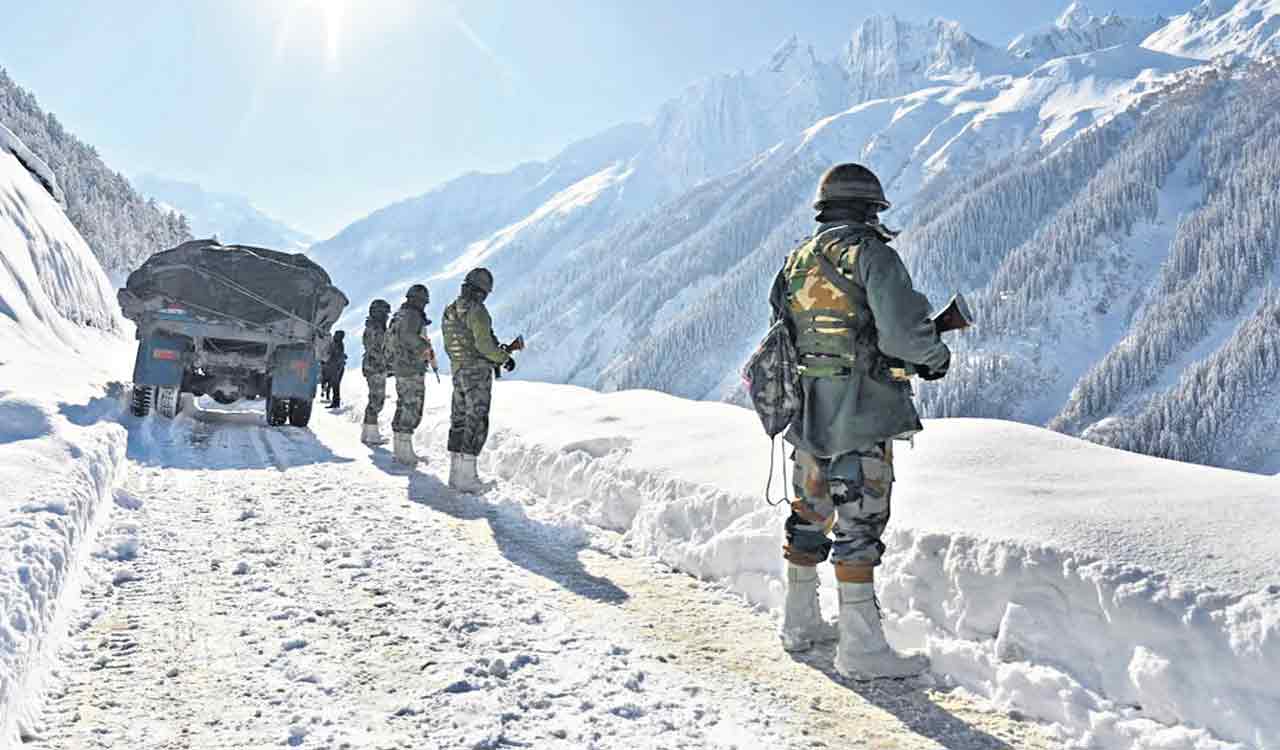
So a Chinese pushdown of the LAC is a probability in spite of the assurance from Lieutenant General RP Kalita, GOC-in-C Eastern Command of the Indian army, that situation in the LAC area is stable. China will cast its eyes on two particular areas – the Chumbi Valley on the India-China-Bhutan trijunction and the Tawang sector in Arunachal Pradesh. If China can widen the Chumbi Valley of Tibet by incorporating a large chunk of Bhutan’s Doklam plateau, then it becomes fit for large military manoeuvres. This valley is quite close to the Siliguri corridor and a successful Chinese pushdown of the Chumbi Valley is enough to cut the corridor and isolate entire northeastern India from the country’s mainland. That China did not resort to this stratagem in 1962 was due to the fact that its control over Tibet was tenuous at that time.
Beijing’s Strategy
This time there are enough hints that Beijing is keeping its powder dry in both the fronts of the northeastern Himalayas. It has raised batches of local militias in the Chumbi Valley comprising Tibetan youths. They have been deployed mostly in the front areas by the People’s Liberation Army (PLA) for using their knowledge of local terrains, languages and customs. Obviously, the purpose is to secure the complete support of the local people in the event of an all-out war with India in and around the Doklam plateau.
China always views its relations with India through the prism of international order while India regards it as a bilateral issue. Much of the difference in value judgments between the two countries stems from this factor. The third term for Xi Jinping as President of China is sure to generate tensions in the Sino-Indian relationship as Xi is certain to judge the Narendra Modi-led government in New Delhi not just from a strategic angle – with New Delhi enjoying a cosy relationship with the US-led axis – but from the angle of his own economic predilections too.
It is widely speculated that China, under Xi’s third term, will veer away from much of the free market economic policies followed during previous years and state sectors will again find prominence. At the same time, Xi is sure to look upon a close neighbour like New Delhi giving free market economic programmes more and more operational spaces as an extension of US hegemonistic dragnets close to China’s backyards.
It is true that so far as the Ukraine war is concerned, India has maintained a balance, not succumbing to American pressure. But for Beijing, that is not enough. It demands more open support from India, particularly in matters of Taiwan. As its worldview is concerned, Beijing’s attitude is not democratic. It is overtly imperialist in nature. So Sino-Indian relations are not likely to smoothen in the near future
PLA’s latest incursions in the Tawang sector should be viewed in this context. The Government of India’s oft-repeated version that much of the LAC is undemarcated and that there is a difference of perceptions about it in the two countries does not explain the situation. It will be interesting to note that there is enough evidence to show that China had already started beefing up its military preparations north of Tawang well before its depredations in the Galwan area of Ladakh and it continued briskly in the post-Galwan period.
(The author is a senior journalist and commentator)

Related News