Opinion: When narratives overpower numbers: Telangana’s shift from evidence to engineering
Telangana, a State born out of data and evidence, now ironically struggles amid overpowering narratives and shifting truths


By Pendyala Mangala Devi
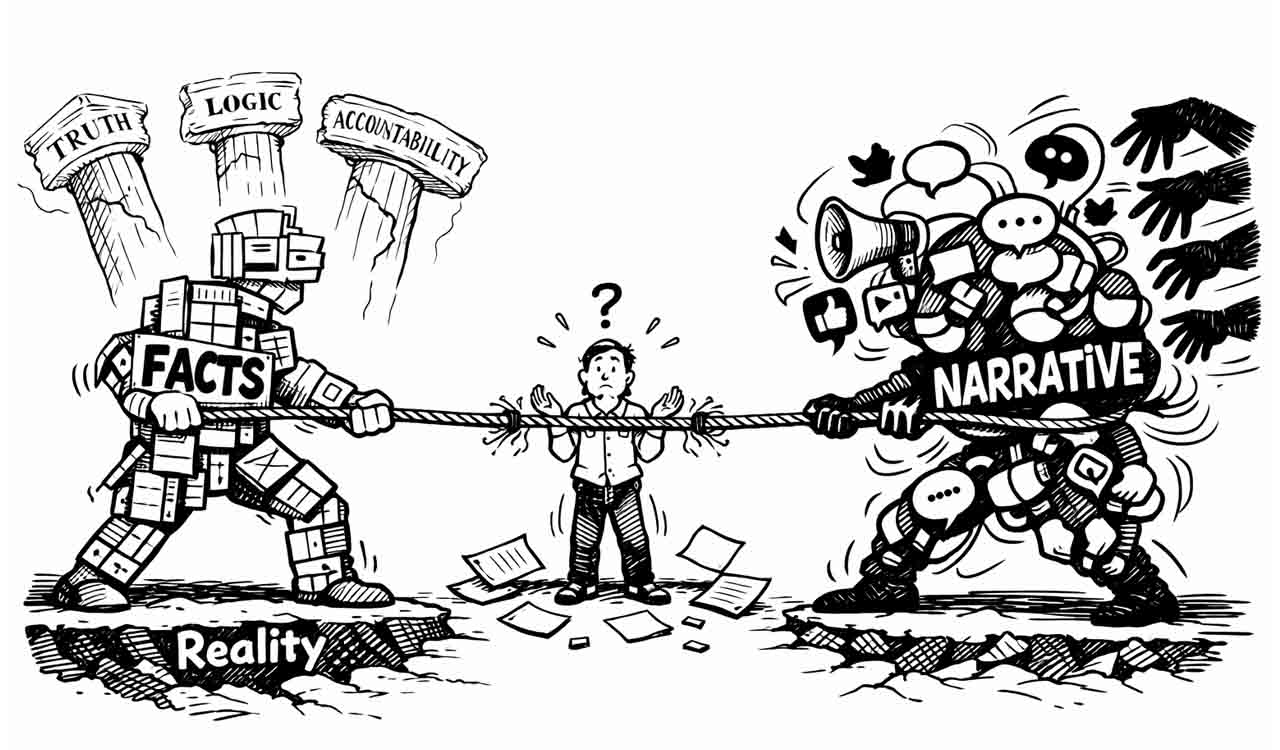
When rhetoric overtakes reason, and amplification replaces accuracy, public discourse ceases to be a search for truth, it becomes a contest for dominance. What we are witnessing is not a mere shift in political communication; it is a structural transformation in how reality itself is constructed, contested, and consumed.
Also Read
Across democracies, politics is no longer anchored in facts; it is driven by narratives. Nowhere is this rupture more striking than in Telangana, a State whose very birth was forged in data, evidence, and statistical argumentation. The irony is not incidental, it is historic. A political identity built on numbers now finds itself engulfed by narratives.
The Statistical Foundation
The Telangana movement remains one of the rare political mobilisations in modern India where facts were not ornamental —they were foundational. The demand for statehood was constructed on rigorously compiled evidence: irrigation inequities, budgetary discrimination, employment imbalances, and systemic neglect. These were not exaggerated claims crafted for applause; they were empirically established realities that carried both moral force and political legitimacy.
Telangana was not merely imagined, it was argued into existence. Numbers became arguments. Statistics became resistance. Data became destiny. And that is precisely why the present moment is so deeply disquieting.
As Socrates warned, “The unexamined life is not worth living.” Today, it is the unexamined narrative that thrives — and therefore dominates. Assertions precede evidence. Circulation precedes verification. Reaction replaces reflection.
From Logos to Narrative Dominance
George Orwell foresaw this distortion with chilling clarity in 1984: “Who controls the past controls the future, who controls the present controls the past.” In the algorithmic age, this is no longer a warning, it is a method. Visibility is curated. Belief is engineered. Legitimacy is manufactured through repetition.
Aristotle’s enduring triad — ethos, pathos, and logos — helps us understand this change clearly. During the Telangana movement, political consciousness was rooted in logos, ie, reason, data, and evidence. It was also driven by pathos, a deep emotional connection to identity, history, and aspiration. There was a strong balance between thinking and feeling.
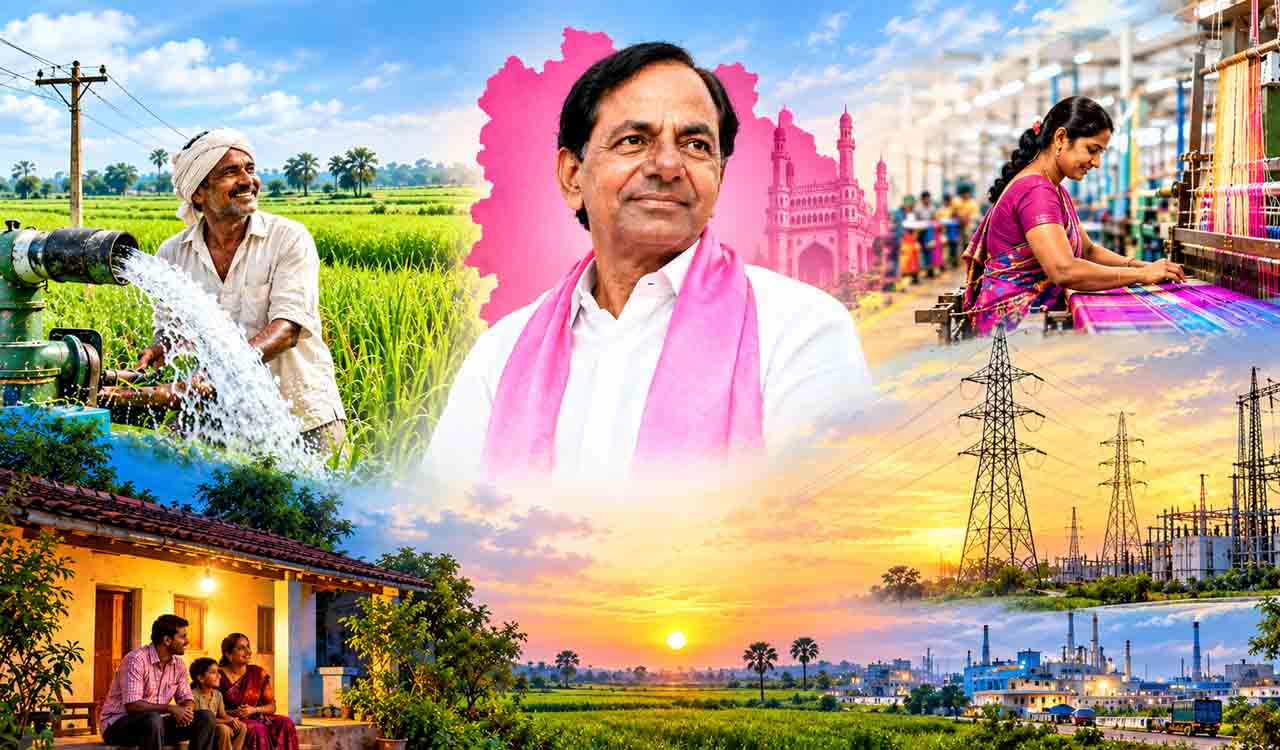
Ethos, or credibility, during this phase was anchored by KCR. It was built through leadership, commitment, and the ability to represent the collective voice of the movement.
Today, that balance is shifting. Pathos, ie, emotion, dominates the arena. Emotions are amplified, often at the cost of facts. Ethos is no longer earned in the same way. It is increasingly shaped through perception rather than performance. Logos, ie, logic and evidence, has not disappeared, but it has been pushed to the background. This is not a natural drift. This is a deliberate design.
Engineering of Perception
Modern political communication is no longer an exchange of ideas; it has become an architecture of influence. As Noam Chomsky explained through the concept of the “manufacture of consent,” public opinion can be shaped not by suppressing information, but by structuring it.
Today, this structuring has become more sophisticated and more insidious. Data is not rejected; it is rearranged. Statistics are not erased; they are selectively illuminated. Context is not debated; it is removed. This phenomenon is starkly visible in Telangana. The political legacy of KCR, forged in the crucible of the Telangana movement and consolidated through governance, has been subjected to systematic narrative reconstruction.
Facts can build states and mobilise people, but when manipulated, they distort perception and erode accountability—what is unfolding in Telangana is not an aberration, but part of a larger pattern
Achievements are fragmented. Context is stripped. Outcomes are compressed into soundbites. Long-term policy impact is reduced to short-term criticism. The objective is not evaluation; it is perception recalibration.
The political transition in Telangana lays bare this transformation. The unseating of KCR was not driven solely by a sustained, data-driven interrogation of governance metrics. It was significantly propelled by a narrative ecosystem where selective drawbacks were amplified, inconvenient contexts were erased, and repetition blurred the line between claim and reality.
A parallel perception was constructed, one where impressions overshadowed evidence, and narrative velocity outpaced statistical truth. In that moment, performance was not defeated by proof; it was overtaken by perception.
Simultaneously, the governance gaps and unfulfilled assurances of the incumbent Indian National Congress government often evade sustained empirical scrutiny. Instead, attention is diverted through cases, commissions, allegations, and counter-narratives. When facts converge, narratives diverge. Amplify selectively. Divert strategically. Dominate perceptually. That is the grammar of contemporary politics.
The Digital Distortion
This transformation is accelerated and normalised by digital platforms. X, Facebook, and YouTube are not passive mediums; they are algorithmic arbiters of attention. They reward intensity over integrity. Outrage over accuracy. Virality over veracity. A manipulated statistic, if emotionally charged, will outrun a verified dataset grounded in context.
Orwell captured this inversion with piercing simplicity: “In a time of universal deceit, telling the truth is a revolutionary act.”
A Crisis of Democratic Substance
The consequences are not rhetorical, they are structural. Public discourse fractures into parallel realities. Citizens no longer argue over interpretations of shared facts, they inhabit entirely different factual universes. Debate degrades into abuse. Scrutiny dissolves into sensationalism. Accountability is displaced by diversion.
Governance, in turn, becomes performative judged not by outcomes, but by narrative control. For Telangana, this is more than a political shift. It is a civilisational contradiction. A society once mobilised by statistical clarity now risks being governed by narrative confusion.
A Return to Discernment
Yet the way forward does not lie in inventing new principles, it lies in rediscovering forgotten ones and applying them with urgency. Gautama Buddha did not merely preach morality; he offered a discipline of communication. Right Speech: speak what is true, speak what is necessary, and speak what does not distort. In today’s climate of noise, that alone is a radical act.
Kautilya did not envision governance as spectacle; he grounded it in evidence, accountability, and consequence. For him, information was not a weapon of manipulation, it was an instrument of statecraft.
Adi Shankaracharya spoke of Viveka, the razor-sharp discernment that separates illusion from reality. In an age where narratives masquerade as truth, this discernment is not philosophical, it is political survival.
And Mahatma Gandhi did not treat truth as convenience. Satya, for him, was non-negotiable. “Truth never damages a cause that is just.” In a time when truth itself is bent to fit causes, this principle stands as both challenge and compass.
Discernment today is not passive understanding. It is active resistance. It is the refusal to accept the incomplete as complete, the distorted as definitive, the loud as legitimate. It is the courage to question what is convenient, and the discipline to verify what is viral. Without this return to discernment, democracy does not fail dramatically, it fades quietly.
The Data of Destiny
Telangana’s history offers both inspiration and warning. Facts can build a state. They can mobilise people, forge identity, and deliver justice. But when manipulated, those same facts can distort perception, fracture discourse, and erode accountability.
What is unfolding in Telangana is not an aberration, it is a pattern. Across Indian politics, numbers are being subordinated to narratives, measurement to messaging, and truth to tactical storytelling.
The warnings from Socrates to George Orwell, from Noam Chomsky to Mahatma Gandhi converge with unmistakable urgency: when truth is displaced by narrative, power no longer needs to justify itself.
And when justification disappears, democracy does not collapse, it mutates. Into spectacle. Into performance. Into perception. Because when numbers are silenced, narratives do not merely speak — they rule.
In the end, the responsibility lies with those who stood for Telangana with truth and facts. They must bring politics back to ethos and logos ie, credibility and evidencenot just pathos. Only then can truth win over perception.

Related News