Being seen, and of seeing
When a leader codes as the ‘face’ of the nation, we must grasp that ‘innocent’ image’s undercurrents


We see in the mass media whole new avatars of leaders and statesmen (the gender is crucial). We see them fly fighter planes, take on the appearance of ancient sages, frolicking with exotic birds, fishing bare-chested in cold climes, being a debonair man-about-town (minus the mask), among others.
These are models of authority and leadership on view: from the saintly to the ultra-machismo, from the businessman to the barrel-chested leader. These models come from history, and with the social media, have found a conduit to transmit images across the nation. The public representations of the monarch were a means of obtaining acceptance of the ‘true’ leader, of ensuring the recognisability of the ruler, and thereby making it clear that there is the ‘raja’ and the ones who see him/her in some format, would be the ‘praja’.
Powerful Images in History
Every leader has worked on her or his image. Those in Literary Studies will recall Queen Elizabeth I as the ‘Virgin Queen’, ‘married’ to England, and others will remember Abraham Lincoln for his outsize hat and steely gaze. Reading the politics of visual culture at the court of King James I, the critic Jonathan Goldberg in James I and the Politics of Literature notes how the portraits of the monarch symbolised his absolutist stance.
The centering of the king, the setting, the angle of the monarch’s eyes, the way the family or the courtiers were arranged around him, all contributed to the iconography of the king as a divinely ordained ruler: absolute, all-powerful, unquestionable. Thus, in the famous Somer portrait (1620), James I is in regal robes, complete with sceptre and orb. The signage in the window behind him reads “dieu et mon droit”: ‘God and my right’, capturing the ‘Divine Right’ theory of monarchy.
But why portraits and images? Before social media and the entire textual apparatus, it was difficult to communicate the message the king or the Church wanted to communicate to the masses. Coins carried the visage of the king as a mode of communicating his identity. Paintings in churches offered up themes from the scripture so that the common man and woman could also receive the stories. It was Pope Gregory the Great (c. 540-604) who gave the rationale: ‘Pictures are placed in churches so that those who cannot read in books might “read” by viewing the walls’. Images, then, are part of the iconography of power, in antiquity and in the present.
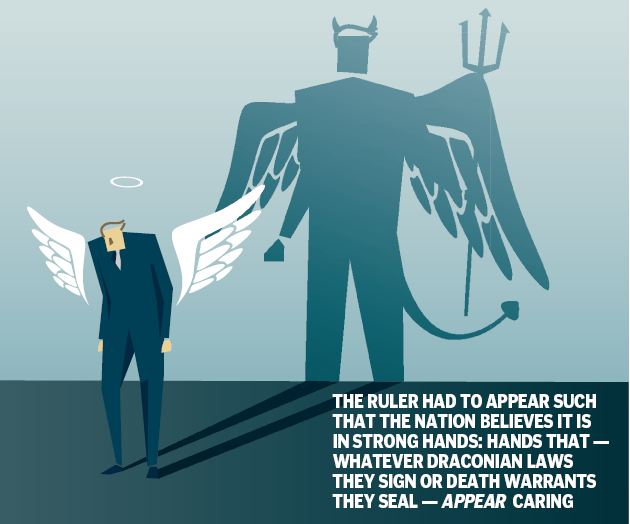
There is a specific public self that has to be fashioned, without signs of weakness, ailments, temper, etc. The ruler had to appear in particular ways so that the nation believes it is in strong hands: hands that – whatever draconian laws they sign or death warrants they seal – appear caring. The eyes, even if they seek the opposition to eliminate or ignore suffering among the citizens, must appear as always directed at the future or higher aspirations.
Artists, Power, Portraiture
Did the artists always communicate what the leaders – the subjects of the art work – want them to communicate? In some cases, the artists themselves gave the lie to the portrait’s subject or offered a cue as to what they themselves thought of the king. In Percy Shelley’s famous ekphrastic poem, ‘Ozymandias’ we are told that Ramses II’s visage, as depicted by the sculptor, was of a man with a ‘frown,/And wrinkled lip’ and communicated a ‘sneer of cold command’. This is the disruption between ‘a sensory presentation and a way of making sense of it’, or dissensus, as the French critic Jacques Rancière terms it.
Dissensus, which is marked by a great deal of aesthetic courage, has been integral to the politics of visual culture, when dealing with dictators and leaders. In Romania, for example, Ferenczi Karolyi and Karolyi Elekes had drawn the dictator Nicolae Ceaușescu as a vampire. The art critic Caterina Preda, in her study of Romanian and Chilean art in the Ceaușescu and Pinochet eras, observes that these regimes used art to present the dictator in certain ways, but ‘the macro perspective of the regime, seen in the articulation of cultural policies, and the micro perspective the artists offer on reality through their artworks’ often clashed, and the latter subverted the traditional images of power.
Iconography to Iconology
The images of leaders in the mass media may be read at three levels. First, we can identify the various objects depicted in them: battle tanks, peacocks, doves, aircraft, tigers, sports equipment, among others. The inexact contemporary equivalent of the sceptre, the orb, the crown or the scroll of the early kings, these objects are inventoried when we look at the images in the pre-iconographical mode, as described by the art historian Erwin Panofsky.
We then move on to the specific symbolism – machismo, confidence, kind-heartedness – of the portraits. We discern, as we are expected to, ability, control, virtue (compassion), battle-readiness in the leader. The man in charge, but also, in turns, kind and gentle, wise and all-knowing. The meditative-reflective man alternates with the man-of-action. The portraiture is supposed to induce confidence in the people that the man has many dimensions to him: he can fight for you but he can also be tender towards you, if need be.
But, finally, we encounter, if we persist, ‘those underlying principles which reveal the basic attitude of a nation, period, a class, a religious or philosophical persuasion’ (Panofsky) in the image. This is where we have to pay attention to the visual politics being played out.
The underlying principles infusing the crop of images of ‘our’ leaders are worrying because, if Panofsky is right, a national ethos and its social imaginary constructed around the image of a militarised leader, for example, implies a nation being led towards, or at least preparing for, conflict. Or there is a specific and highly visible religious and/or regional identity being drawn upon and out, unobtrusively, legitimising that identity as a ‘national’ one. Or, when represented in the ‘lap of Nature’, conquering it or domesticating animals or birds, we are presented a romanticised view of a leader, and by extension, of a wild, untamed nation destined to be subdued.
The leader codes as the ‘face’ of the nation, and the iconological calls us to see what we are being persuaded by the undercurrents to an ‘innocent’ image may mean. To move from the iconography of a hero to the iconological subtexts that propose a national attitude or a collective mythology is to be aware of the politics of being seen, and of seeing.
(The author is Professor, Department of English, University of Hyderabad)
Now you can get handpicked stories from Telangana Today on Telegram everyday. Click the link to subscribe.
Click to follow Telangana Today Facebook page and Twitter .

Related News