Bifurcation of Andhra Pradesh and Telangana: An economic reckoning
The bifurcation exposed fiscal imbalances and divergent growth paths, with Andhra Pradesh relying on central support and Telangana pursuing investment-led growth


By JR Janumpalli
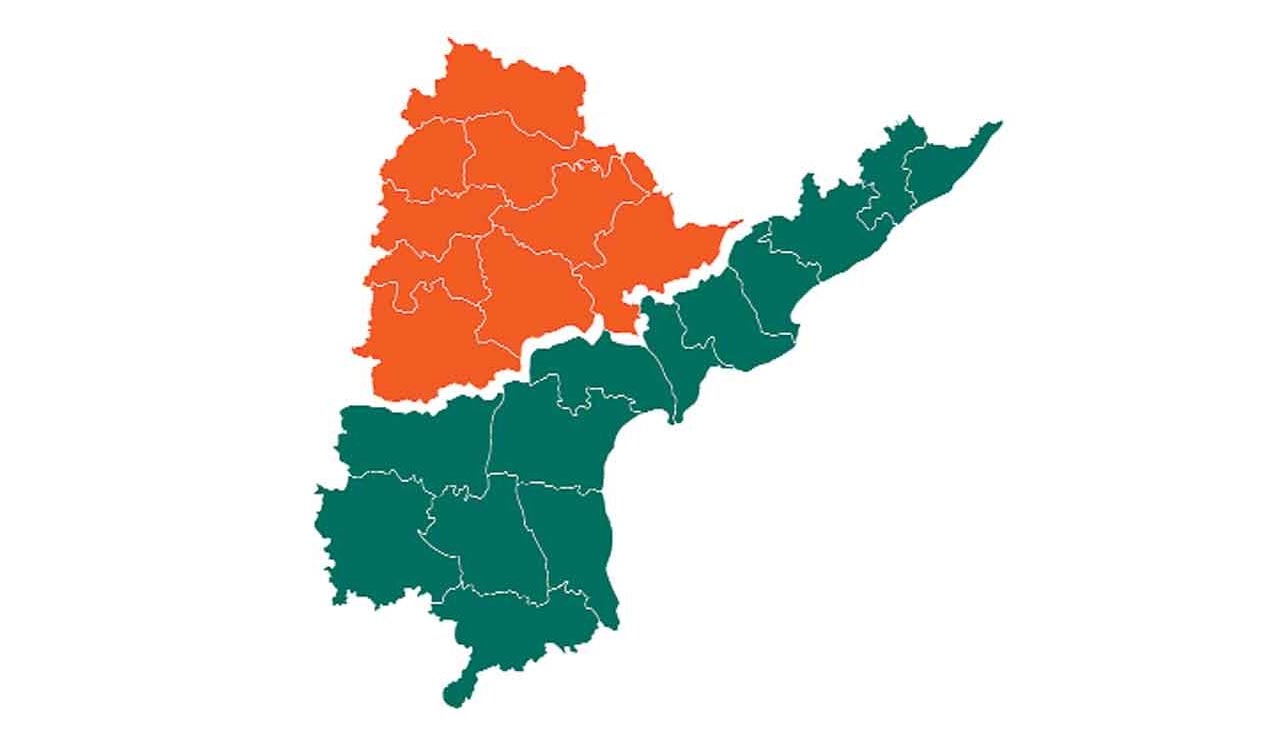
The demerger of Andhra Pradesh in 2014, which led to the creation of the new State of Telangana, was not merely a political event but a profound economic restructuring. It exposed decades of fiscal imbalances, regional neglect, and structural dependencies that had been masked under the united Andhra Pradesh.
After the split, the central government treated Andhra Pradesh as the “victim”, showering it with special endowments and financial assistance, while Telangana was left to fend for itself — as if the very act of granting statehood was a sufficient gift to the region.
Historical Context
Hyderabad has remained a point of contention for Andhra Pradesh after the demerger. Andhra’s peripheral relationship with the Hyderabad kingdom ended between 1780 and 1800 when the Circars (Coastal Andhra) and Rayalaseema districts were ceded to the British and came under British colonial rule.
Before 1953, the Andhra region was part of the Madras Presidency for over 150 years. By contrast, Hyderabad was the capital of the princely State of Hyderabad from its founding in 1591 until 1948, and is situated in the heart of Telangana, about 250 km away from the Andhra border.
In 1953, the first linguistic State after independence, Andhra State was carved out with Kurnool as its capital. In hindsight, this proved to be a premature decision and a historical mistake. The Andhra region was financially weak and dependent on the Madras State. Its chronic revenue deficit became immediately evident, rendering the State economically unviable.
In 1956, taking advantage of the States Reorganisation process, and despite opposition from the States Reorganisation Commission and the people of Telangana, Andhra leaders, owing to their proximity to the Congress central government, managed to merge the financially weak Andhra with Telangana. The intent was to utilise Hyderabad as a developed capital and Telangana’s surplus revenues to make Andhra economically viable.
Thus, Andhra and Telangana were forced to come together and remained united for 58 years, compared with Andhra’s much longer association with the Madras Presidency for 160 years. This historical backdrop is crucial to understanding Hyderabad’s relations with both the regions and its impact.
Revenue Contribution, Spending Patterns
At the time of the merger, Andhra faced a Rs 4 crore revenue deficit, while Telangana had a Rs 1 crore surplus. As per the States Reorganisation Commission in 1955-56, the per capita revenue of Andhra and Telangana was Rs 10.53 and Rs 15.04, respectively (ratio of 1.00:1.43). During the united Andhra Pradesh era, Telangana’s surplus revenues were used to offset deficits in Andhra and Rayalaseema.
Though both Andhra (13 districts) and Telangana (10 districts) regions contributed roughly 50% each to state revenue, expenditure was significantly skewed—about 35% in Telangana and 65% in Andhra—despite agreements prohibiting diversion of Telangana’s revenues.
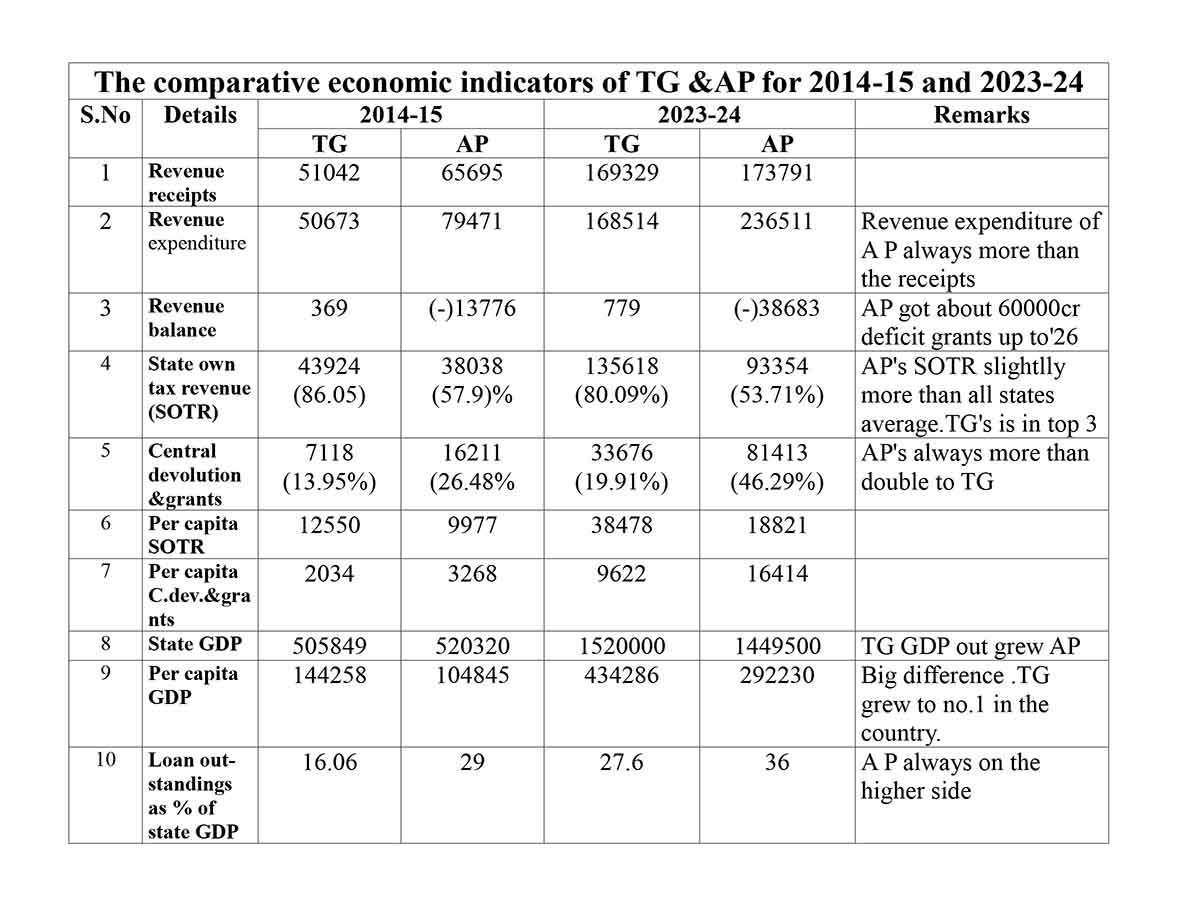
This pattern persisted until the demerger. In 2014–15, Andhra recorded a Rs 13,337 crore deficit, while Telangana posted a Rs 369 crore surplus, replicating the pre-merger scenario. Since the Andhra government could use Telangana revenue as it pleased, it never bothered to bridge the gap between revenue income and expenditure in the Andhra region. Post-demerger, the State Own Tax Revenue (SOTR) of Telangana averaged around 75% of total revenue receipts, as against 52% for Andhra Pradesh.
Post-Demerger Fiscal Parameters
• Andhra Pradesh: Inherited Rs 13,377 crore deficit in 2014–15. The Centre provided about Rs 11,500 crore after recalculations, along with Rs 52,000 crore in revenue deficit grants through the 14th and 15th Finance Commissions (till 2026). Despite this, Andhra’s deficit ballooned to Rs 38,683 crore by 2023–24. Debts increased from Rs 1.2 lakh crore in 2014–15 to Rs 3.1 lakh crore in 2023–24.
• Telangana: Began with a Rs 369 crore surplus, rising to Rs 5,994 crore by 2022–23 and Rs 779 crore in 2023-24, despite heavy borrowing for infrastructure projects like Mission Bhagiratha (drinking water), Mission Kaktiya, Kaleshwaram, PRLI irrigation, and power expansion. Debts rose from Rs 0.8 lakh crore in 2014–15 to Rs 2.3 lakh crore in 2023–24. Crucially, this investment created tangible assets and boosted revenues.
Though the NITI Aayog recommended Rs 24,000 crore support for these projects, it was never implemented.
Hyderabad: Loss or Dependency?
The repeated refrain of Andhra Pradesh losing Hyderabad is misleading. Hyderabad has always been part of Telangana. Andhra had lost its political link with Hyderabad in 1780-1800 AD, and its reliance on Hyderabad’s revenues was a fiscal choice, not an entitlement. The demerger exposed this dependency. The restoration of Hyderabad’s revenues to Telangana corrected a long-contested injustice.
Asymmetry and Fairness
The Centre’s assistance to the two States after demerger has been highly asymmetrical:
- Andhra received 20 national institutions and infrastructure projects, under the AP Reorganisation Act; Telangana got just 6.
- Andhra received Rs 11,500 crore in 2014–15, plus Rs 52,000 crore from 2015-16 to 2025-26.
- Polavaram was declared a national project with full central funding. Some other Krishna basin projects were approved without recognition of a statutory Tribunal.
- Special packages were extended to backward districts in Andhra Pradesh—Rayalaseema and North Coastal Andhra.
- In contrast, Telangana, whose 9 districts were declared earlier backward by the Centre, received no such special aid and was forced to borrow heavily for reconstruction.
The Fairness Debate
The asymmetry in central assistance raises questions of equity. Andhra Pradesh was cushioned with grants and projects, while Telangana financed its reconstruction through debt. Polavaram’s full central funding and Amaravati’s financial indulgence contrast sharply with Telangana’s self-financed irrigation and power projects. Andhra was effectively rewarded for decades of exploitation, while Telangana was penalised for asserting its right to statehood.
Both national parties treated Telangana as a political orphan. Yet Telangana proved its worth, earning the sobriquet of “possibly the number one State in the country over the past 10 years.”
The demerger was both a political and an economic reckoning. Andhra Pradesh’s fiscal challenges reflect decades of dependency on Telangana’s revenues, while Telangana’s trajectory reflects reconstruction and investment-led growth. The story of Andhra and Telangana is a lesson in the lack of cultural assimilation, regional equity, and fiscal responsibility, as well as the dangers of majority political hegemony and federal imbalance.

(The author is a freelance journalist)

Related News