Opinion: Beyond carriers of Colonialism
Set up to serve British interests, Railways, however, transformed India into a socio-political entity


By KSS Seshan
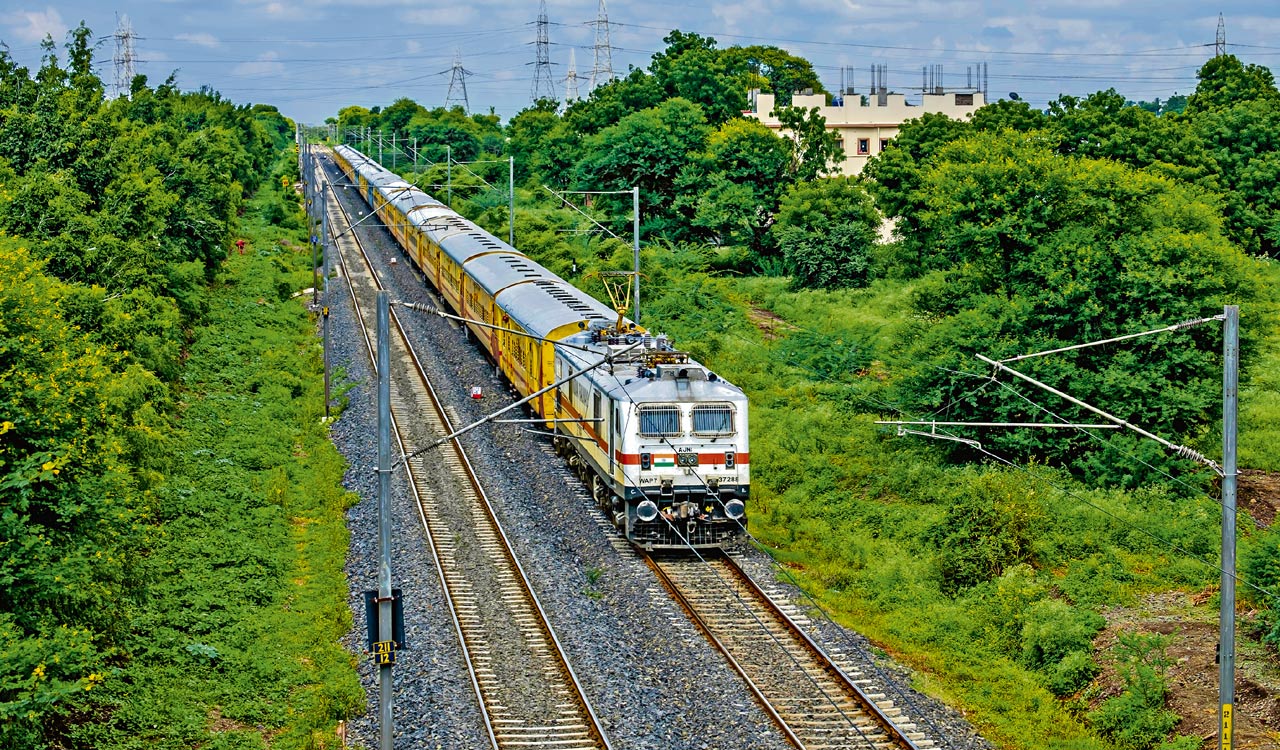
The Railway network in India with a total route length of more than 68,000 km and running track length of about one lakh km is the fourth largest in the world, next only to the US, Russia and China. The entire rail system in India has 18 operational Divisions and has the largest workforce with more than 12 lakh employees. Nearly 13,000 passenger trains run daily carrying 800 crore people annually. The Railways earns a revenue of about Rs 2,40,000 crore annually. There are a staggering 7,325 stations across the country.
Also Read
However, the railways when introduced, was meant to serve the cause of British interests, their trade and industry, and never were for the benefit of the natives. In fact, British colonialism got strengthened with the advent of railways in India.
Origins in England
The first-ever rail line in the world was laid in 1825 between Stockton and Darlington in the coal-rich Durham region in Eastern England. The rails were laid on which carriages laden with coal were hauled using packs of horses. In 1830, the first passenger rail was laid from Manchester to Liverpool with the locomotive, Rocket, developed by Stephenson, a school dropout, making use of the steam engine that was invented earlier by James Watt. Today there is an imposing bronze statue of Stephenson at the ever-busy Euston station not far from the British Library in central London. Within 25 years, India had its first railway line in 1853 running from Bori Bandar in Bombay to Thane, a suburb of the metropolis.
Dalhousie, the Governor General of India ( 1848-1856), had boasted that he introduced three engines of social advancement in India and they were: the Railways, the Telegraph and cheap postage. The mind of the British was clear when on 16 December 1853 Dalhousie in his celebrated minutes declared that the Railways was needed in India to make the British rule a reality. He said they were to serve as carriers of agricultural raw materials like cotton, jute and Indigo from rural India to the nearest port to be shipped to England to feed the mills in Manchester, Glasgow, Lancashire, Liverpool, Skylark etc.
The other purpose, according to Dalhousie, was that the Railways would carry British finished goods from the Indian port towns to be dumped in the captured markets in the country’s hinterland. Dalhousie’s plans were also in consonance with the international developments of the day. The British thought that India disappointed them on two counts. Firstly, India did not supply raw materials like cotton as America did. But after the Civil War and after slavery was abolished, American cotton was not to come to Britain.
Secondly, India, though a part of the Empire, did not absorb British goods as other countries did. Brazil, for example, purchased British goods ten times more than India. After the Charter Act of 1833, England wanted to capture not only Indian goods but even the Indian markets. For that purpose, the transport revolution through the Railways became necessary.
Positive Effects
Railways transformed India from a geographical expression to a socio-political entity. The Indian economy was linked to the world economy due to the Railway network. Indian agriculture could go commercial. The national movement became widespread as delegates from far-off places like Bombay, Calcutta and Madras could travel to attend the Indian National Congress sessions. Caste barriers also declined as people of all classes huddled together while travelling. Industrial culture spread to Bombay and Ahmedabad through textile mills due to the mobility of people using railways.
But on the economic front, the Railways was beset with numerous disastrous consequences. Gopal Krishna Gokhale, the great nationalist and freedom fighter, once said that Indians were never against the Railways but what they did not like was the way the British were introducing it at break-neck speed in preference to other aspects like irrigation. “Every mile of rail that you lay has added a fresh nail to the coffin of the Indian Economy,” he said.
Several well-meaning British administrators also opposed the introduction of the Railways in India ignoring other developmental activities. Sir Arthur Cotton who was instrumental in major irrigation works like the Krishna Barrage and Dowlaiswaram anicut, said, “When India craved for water for its perched lands, we are driving steel into it”. He made it clear that irrigation was needed for production while the Railways was useful only for distribution.
Private Enterprises
The Indian Railways initially were run only by private companies. By 1845, the Great Indian Peninsula Railway Company, the East Indian Railway Company, the Madras Railway etc were established to lay the rail lines in several parts of the country. By 1869, there were as many as eight such private rail companies in India. As a result, in 1853, the first-ever Bombay to Thane line was completed. In 1854, Calcutta to Raniganj line was laid in the east for transporting coal.
In south India, in 1856, the Madras-Arakkonam was completed. It was later extended up to Renigunta. Soon, all the Presidency towns — Madras, Bombay and Calcutta — were connected by Railways. The Railways were provided with a separate Budget from 1924.
The development of Railways in India had several distinct stages. During the initial stage, a guarantee system was followed when the private rail companies were given liberal guarantees. Under this system, the shareholders were given a minimum 5% interest as a guarantee. Companies had leases for 99 years and land for laying the rails was given free of cost. If the government was not happy with the companies they could not take over before 25 years. But if the companies wanted to wind up, they could do so by giving a mere 6 months” notice. Mail had to be carried free. Army men and materials were to be transported by the Railways at concessional rates. The British investors were happy at the 5% as “they did not bother whether the money was converted to brick and mortar or thrown into Hooghly”. So, everything for the private companies and nothing for the government. It was like ‘heads I win, tails you lose’
Degenerative Role
Railways in India were developed at an alarming pace neglecting irrigational facilities. In 1902 for example, irrigation got Rs 43 crore while the government spent Rs 350 crore on the Railways. All rolling stock like rails, engines and rakes were made in Britain. As raw materials and foodgrains were taken away using the Railways, famines in India became more frequent, more widespread and more severe. People died like flies during such famines and the government did precious little during such periods. Indian economy suffered as the drain became more rampant due to railway expansion resulting in deindustrialisation.
At the same time, British interests were highly secured due to the Railways and they could send armies across the country easily. The success of the British in the 1857 Revolt largely was due to such quick mobility of the armies using railways.
Gopal Krishna Gokhale once said Indians were never against Railways but did not like the way the British were introducing it in preference to other sectors like irrigation

Related News