Opinion: Why we need sponge cities
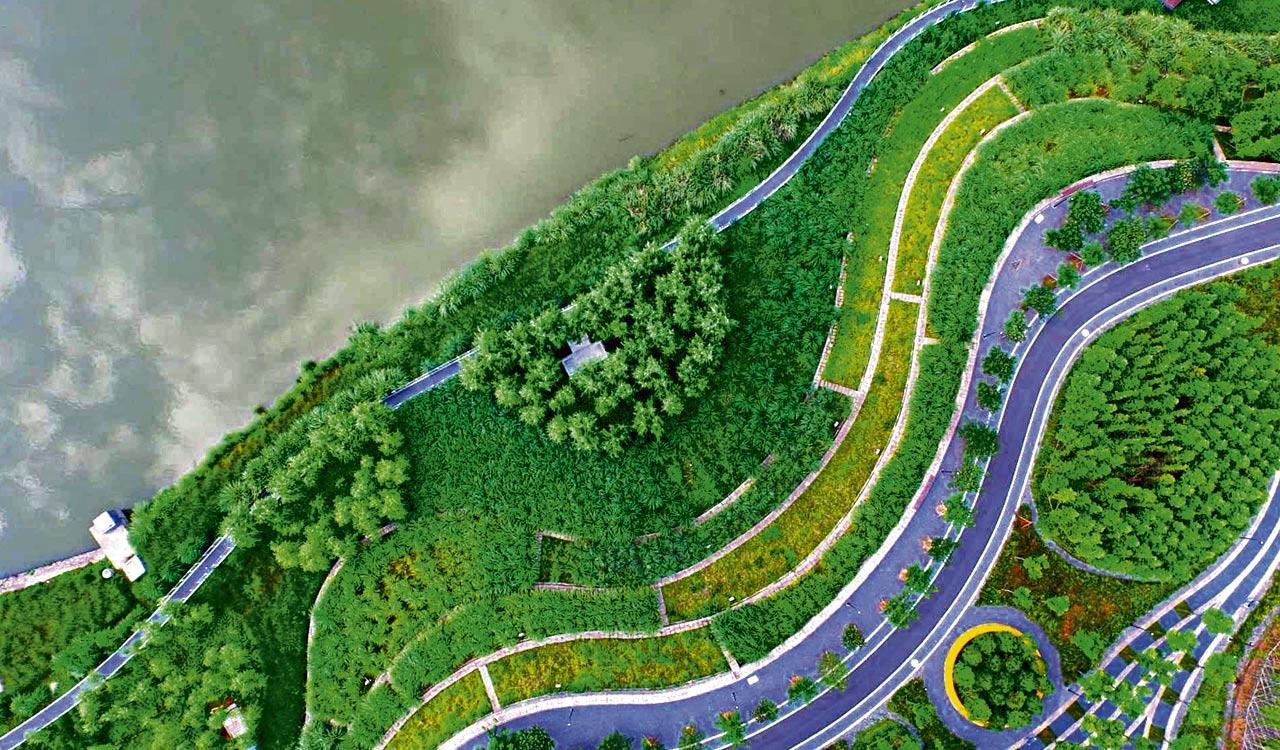
Under its Sponge City Initiative, the Chinese government is building water-absorbent projects in 30 cities


By Shivani Pandey
Scientists are enthusiastically proposing ‘sponge cities’ as sustainable futuristic cities where ‘almost every drop of water is captured, recollected and reused when needed much like a sponge’. Thus, this can be a sustained step towards the visionary ‘circular economy’.
Also Read
As climate change brings floods and creates havoc, there is a growing need for planning cities in a way that they act like giant sponges that allow water to drain away safely.
Making of Sponge City
The term ‘sponge cities’ is used to describe urban areas with wide natural areas such as trees, lakes and parks which allow them to absorb more rainwater and prevent flooding.
• Sponge city follows the philosophy of innovation — that a city can itself solve water problems instead of creating them.
• Instead of funnelling rainwater away, a sponge city retains it for use within its own boundaries.
• Some might be used to recharge depleted aquifers or irrigate gardens and urban farms.
• Some could replace the drinking water we use to flush our toilets and clean our homes.
• It could even be processed to make it clean enough to drink.
In the present scenario, smart methods, mostly nature-based solutions, have gained widespread popularity, given their sustainability and affordability.
Major cities across the world such as New York City, Shanghai, Tokyo and Cardiff are embracing their “sponginess” by creating inner-city gardens, and expanding river drainage and city walks.
It Matters
As per the recent Intergovernmental Panel on Climate Change (IPCC) report, 700 million people already live in areas with see extreme rainfall. This number is expected to exceed as global temperatures rise. For a diverse country like India with almost every range of topography, the effects of climate change are not the same everywhere, and thus the planning methodology we are adopting cannot be the same too.
Since 2013, Himalayan States like Uttarakhand and Himachal Pradesh are facing frequent flash floods with high casualties besides massive damage to infrastructure. The ‘Chamoli disaster’ of 2021 hit the hardest with severe casualties. Himachal Pradesh is now bearing the brunt of climate change as nature strikes back with heavy rains resulting in flash floods, causing irreparable damage.
In the last couple of years, even big cities like Mumbai, Ahmedabad, Chandigarh and Chennai have faced the same challenge. In addition to this, urban flooding has become a recurrent feature in Indian metros. Cities are getting bigger, and so is the threat of climate change. There is no long-term strategy on how to tackle such challenges of climate change.
When we build cities, we tend to build them on natural aquifers, wetlands, catchments and ponds, which leads to blocking the natural exit option. These actually have the ability to soak in extra water.
The Significance
How can sponge cities offer a solution? An equal benefit of sponge cities is that they can hold more water in rivers, thus enhancing greenery. Instead of losing water to evaporation, this water is brought to plants. In fact, this is really a drought-resilient methodology.
The affordability factor a sponge city provides is far better than other urban planning solutions. According to the World Economic Forum, natural ways to absorb urban water are about 50 per cent more efficient than man-made solutions.
Sponge cities come with many social benefits as well by providing enhanced green spaces. Associated strategies such as green space can improve the quality of life, air and reduce urban heat islands. In such a scenario, water can be used to keep green spaces verdant, providing outdoor areas for the people and even be used to grow food.
This, in turn, can improve urban ecosystem diversity by providing new habitats for a wider range of organisms, much like how groves and sanctuary offer.
But how to measure the “sponginess” factor? The blue and green infrastructure including grass, trees, lakes and other water bodies is basically compared with the grey infrastructure which includes concrete structures, pavements and buildings, and thus determining how much spongy a space is.
International Examples
China has embraced the idea of sponge cities enthusiastically. Under its ‘Sponge City Initiative’, the Chinese government is building water-absorbent projects in 30 cities. The plan is to manage 60 per cent of rainwater falling in the cities by developing ponds and wetlands, and building permeable roads and public spaces that enable stormwater to soak into the ground.
Similarly, European countries like Albania and Sierra Leone are giving the sponge concept a try by planting trees to help prevent future disasters.
Boosting Absorbency
City planning must not be merely set in stone. An increased number of parks, trees, other green spaces and natural drainage can boost a city’s absorbency and make it more flood- and drought-resistance.
However, transforming entire cities into sponges will require massive investments. Keeping in mind the affordability factor and the multiplier effect, this concept should be tried seriously.
Indian cities must become ‘sponge cities’ to tackle urban flooding. In the long run, this will reduce carbon footprint too, helping India in its INDC (intended nationally determined contribution) goals and prevent climate change to a large extent.
With growing urbanisation and increasing urban floods, it is time for India to move towards sponge cities.


Related News