Plugging the gaps in NEP
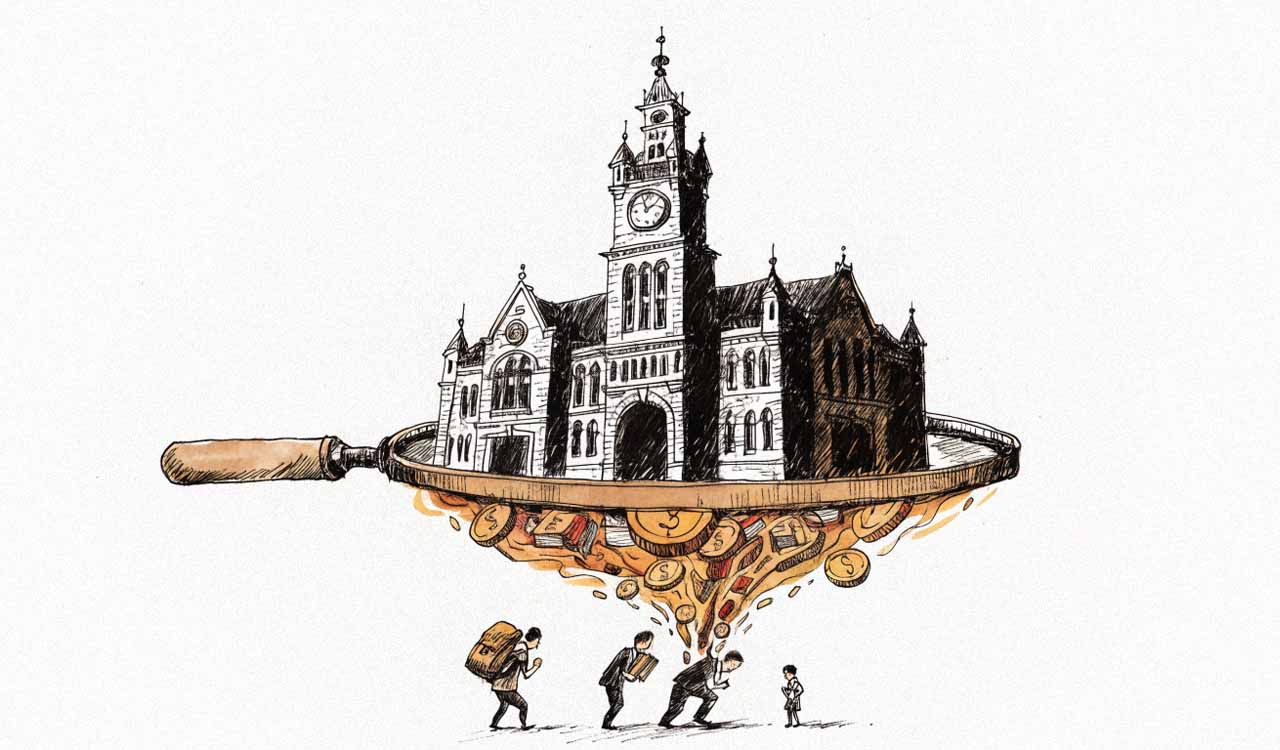
Colleges should continue to be affiliated to universities to ensure quality education



Higher education trains the youth in their chosen subjects, makes them understand complexities, enables critical thinking and analysis and inspires them. Higher education plays a crucial role in providing better job opportunities in a knowledge-based society.
Higher education in India has evolved over time. From free and compulsory education (Daulat Singh Kothari, 1968), introducing adult education, population education and technical education (Acharya Ramamurthy, 1986); establishing National Knowledge Commission with a five-point programme on Access, Concepts, Creation, Application and Service (Sam Pitroda, 2005); to a strategy to make India a global knowledge superpower by adopting an inclusive, participatory and holistic approach (Dr K Kasturirangan, 2020), higher education has been changing in step with the needs of society.
On 29 July 2020, the government of India approved the National Education Policy 2020. The policy aims at universalisation of education, starting from pre-school to secondary level with a 100% Gross Enrolment Ratio. The aim of education as defined by the NEP 2020 is to achieve full human potential, develop an equitable society and promote national development.
The NEP curriculum is more inclined towards critical thinking, discussion and analytical learning. Overall, the NEP aims for trained human resources, who will create value prepositions closer to international standards, with a focus on:
* One nation and one curriculum
* A single regulator for higher educational institutions
* Scheme of multiple entry and exit options in Degree courses
* Common entrance exam for universities
* Common norms for private and state-funded universities
* Granting autonomy to colleges and affiliation to colleges phase-out in 15 years
* Multidisciplinary education system
* Introducing 3 – or 4-year Degree courses
* Categorising as research-incentive and teaching-incentive universities
* Allocation of budget should be 6% of GDP
* No Intermediate; no MPhil
The main aim of NEP 2020 is to provide equitable and inclusive education for creating knowledge and promoting application of knowledge with inclusive growth. Some of the key changes that the NEP brings in and need deliberations are:
3 -or 4-year Degree: All colleges shall have a 3-or-4 year undergraduate programme. While a 3-year programme will lead to a Degree, 4-year Degree programme could lead to a research Degree.
Autonomy: If autonomy is granted to Degree colleges, those colleges may not be part of Universities. They will have their own academic calendar, teaching arrangement, examination schedule and own income and expenditure.
In India, most of the private colleges run with a profit motive by violating many norms, including teaching hours, engaging all the classes with a single teacher, not maintaining teacher-student ratio and only focusing on coverage of syllabus rather than dissemination of knowledge.
Autonomous colleges will have to prepare the examination question paper, conduct exams for their own students, evaluate answer sheets by their own faculty members and finally, will have the authority to moderate the results. To get the funds from the government, appreciation from parents and to attract more students, autonomous colleges may indulge in malpractices by granting higher marks and distinctions to their own students. Therefore, autonomy must be granted only with affiliations to the universities.
This will also impact the income of state-funded universities. Most of these universities have been sustaining because of affiliation fees, examination and certificate fees, and other kinds of fees of the affiliated colleges. In such circumstances, universities should have control over colleges for recruiting faculty, qualification of teachers and workload of faculty members. If autonomy is granted to all the colleges, private autonomous colleges are likely to indulge in malpractices like paying less salary.
Almost all private colleges across India — medical or Degree — are established by powerful people. So, these colleges are smart enough to get the UGC/AICTE/ICSSR/ICMR/DRDO funds because of political influence or corporate lobbying. This will seriously affect the academic atmosphere in the country.
Multidiscipline Education System: The Indian education system has moved to being interdisciplinary from the traditional system. Now, NEP 2020 has also stated that multidisciplinary education system should prevail. But there is always time constraints in teaching irrelevant subjects to students. It is also linked to the availability of subject faculty, labs and resources. Hence, it is better to introduce a structuralism system, which is problem-focused and contextualised to real problems and solutions. It is providing responses to a particular system with appropriate solutions.
Spending on education should be 6% of GDP: Spending on higher education should be 6% of the GDP. But higher education is on the Concurrent list and so the expenditure must be shared by the Central and State governments. Some of the North and Northeastern States have not implemented even the 6th pay revision, some States have not changed the nomenclature of the faculty members, and some have not enhanced Dearness Allowances for the teachers despite several guidelines by the UGC/courts. Therefore, allocating adequate budget will be key to achieving the objectives of the NEP.
Though the NEP has the provision of fee cap, experience shows that private managements are expert enough to collect various fees from students in various modes. Ultimately, it encourages dropout or non-completion of courses. There should be a mechanism to properly implement fee cap.
The NEP provides practical-oriented, innovative and value-based, technical and skills-based, and employability or entrepreneurship-oriented education by providing greater autonomy to the higher education institutions with the freedom to opt for interested subjects. But the State or Central governments should bring certain changes in the NEP to enable retaining the autonomy of the universities for providing quality education.
Prof D Chennappa
The NEP will become better if the following are focused on:
* Autonomy may be granted to institution only with affiliation to universities
* Go for structuralism instead of multidisciplinary education
* 6% of GDP should be allocated for education
* All structural reforms must be student-centric
(The author is Principal, University College of Commerce and Business Management, Osmania University)
Now you can get handpicked stories from Telangana Today on Telegram everyday. Click the link to subscribe.
Click to follow Telangana Today Facebook page and Twitter .

Related News