Opinion: What three schools in Arunachal revealed beyond exams and classrooms
Meaningful education is not just about gaining new knowledge, but also recognising the value of knowledge that already exists


By Mourya Viswanadha
When I travelled to Lower Dibang Valley in Arunachal Pradesh, my objective was clear. Over three days, I would work with teachers and students across three schools, conducting sessions on Assessment for Learning (AFL) while exploring questions related to Education for Sustainable Development, Indigenous Knowledge and Cultural Diversity, and Teacher Capacity and Equity.
Also Read
I arrived with lesson plans, frameworks, and a fairly structured understanding of what I hoped to accomplish. I left with a deeper appreciation for a question that continues to stay with me: What happens when education moves beyond the classroom and reconnects with life?
The journey took me through Intaya Public School, Vivekananda Kendra Vidyalaya, and PM SHRI Jawahar Navodaya Vidyalaya in Roing. Every classroom observation, teacher discussion, and student conversation seemed to point toward a larger realisation: meaningful learning often occurs in places that formal education does not always recognise.
The Edge of the Map
Ancient cartographers often marked unexplored regions of their maps with a warning: Here Be Dragons. The phrase was not necessarily a claim that dragons existed. Rather, it signified the limits of what was known. Beyond that point lay uncertainty, possibility, and discovery. The map ended there, but the world did not.
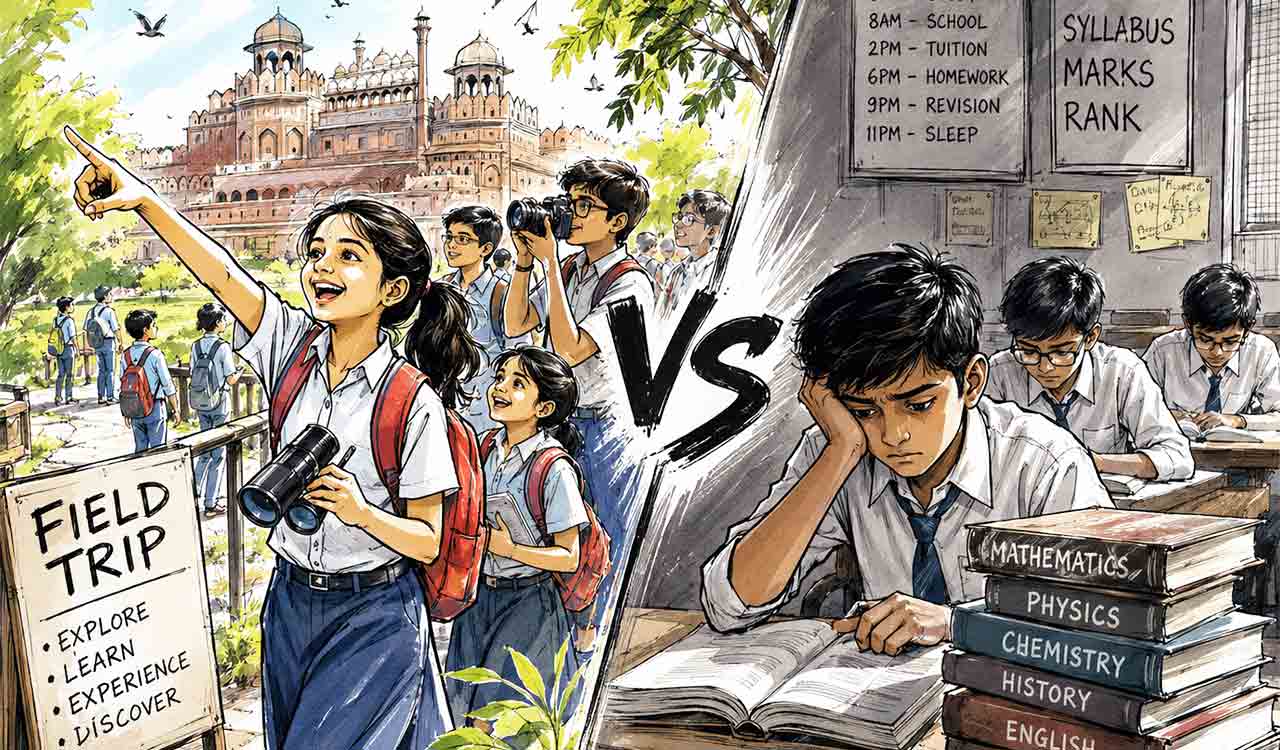
Modern education has its own maps. Curricula, examinations, lesson plans, assessment systems, and learning outcomes help us navigate learning. They provide structure, direction, and consistency. Yet, like all maps, they represent reality rather than reality itself.
In Lower Dibang Valley, I found myself repeatedly encountering learning beyond those familiar boundaries. At Intaya Public School, my discussions with teachers focused on how children learn, how thinking develops, and how classroom observations can become evidence that strengthens teaching. We explored AFL as a process that supports learning rather than merely measures it.
During interactions with students, I met an aspiring novelist and a young filmmaker. Their ambitions immediately captured my attention. Not because such aspirations are rare, but because they served as a reminder that education is not simply about preparing students for examinations. It is also about helping them imagine futures for themselves.
At Vivekananda Kendra Vidyalaya, many students spoke passionately about football and their dream of representing India. Our conversations moved beyond careers and into questions of discipline, resilience, consistency, and mindset. These students were already learning lessons that could never be fully captured by an examination score.
At Jawahar Navodaya Vidyalaya, discussions centred around aspirations, interests, and future pathways. Students demonstrated remarkable clarity about their ambitions while also expressing the uncertainties that naturally accompany them.
Across all three schools, I encountered students who were curious, creative, and eager to learn. More importantly, I encountered young people trying to understand who they were and who they hoped to become. The more conversations I had, the more I felt I was moving toward the edges of my own map of education.
Beyond curriculum and assessment lay questions of identity, purpose, creativity, culture, and belonging. Some of the most meaningful learning I witnessed was taking place precisely where the educational map seemed to end.
Learning Beyond Assessment
Traditional assessment systems often focus on answering a single question: What did students learn? AFL begins with a different question: How are students learning? This distinction may appear subtle, but it changes the role of assessment entirely.
Rather than functioning as a tool that evaluates learning after it has occurred, assessment becomes an active part of the learning process itself. Observation, questioning, feedback, reflection, and adaptation become central to teaching rather than supplementary activities.
As I observed classrooms and engaged with teachers, I began noticing patterns that extended beyond assessment. Students appeared to learn most effectively when they engaged not only in practice and performance but also in reflection and planning. Similarly, teaching became most effective when educators continuously observed student understanding, analysed learning patterns, adapted instruction, and reflected on outcomes.
When ancient cartographers reached the limits of their knowledge, they wrote “Here Be Dragons.” Beyond those boundaries lay the unknown. Education, too, has its frontiers—where learning extends beyond classrooms, exams, and familiar assumptions into new realms of discovery
These observations gradually evolved into two interconnected ideas. The first was a Learning Cycle from the student perspective, emphasising the relationship between practice, performance, reflection, and planning. The second was a Teaching Cycle from the teacher’s perspective, emphasising observation, analysis, feedback, adaptation, and reflection.
Both cycles pointed toward the same conclusion: learning is not a linear process. It is iterative. Growth occurs through continuous engagement, feedback, adjustment, and reflection. The classroom, therefore, is not merely a place where knowledge is delivered. It is a living system in which understanding is constantly being constructed, challenged, refined, and rebuilt.
Learning from the Valley
Education often assumes that knowledge flows in a single direction—from textbooks to classrooms, from institutions to learners. Yet some of the most valuable knowledge exists outside those formal structures. Cultural traditions, local practices, environmental understanding, and lived experiences embody generations of learning that deserve recognition alongside academic knowledge.
Meaningful education is not simply about acquiring new knowledge; it is also about learning to recognise the value of knowledge that has always been present.
The Ship of Theseus
The ancient paradox of the Ship of Theseus asks whether a ship remains the same after every plank has gradually been replaced. Looking back, Lower Dibang Valley feels less like a destination and more like a shipyard. No single conversation transformed my thinking. No single classroom observation altered my perspective. Instead, change occurred gradually.
A discussion about student aspirations replaced one assumption. An observation about contextual learning replaced another. Conversations about sustainability, indigenous knowledge, teacher development, assessment, and equity quietly altered others. Plank by plank, my understanding of education began to shift.
The visit also became the foundation for several ideas that continued to evolve after I returned. Reflections on learning processes and classroom practice contributed to the development of the Learning Cycle, the Teaching Cycle, and a broader categorisation of teaching and formative assessment methods. Most significantly, the experience contributed to the emergence of the Integrated Regenerative Learning Method (IRLM).
At its core, IRLM rests on a simple belief: learning should not end with understanding. Learning should lead to implementation. Students should not merely acquire knowledge. They should use that knowledge to engage with the world around them, connect learning with lived realities, and transform understanding into meaningful action. In this sense, learning is not complete when a concept is understood. Learning becomes meaningful when understanding is translated into action.
At the Edges of Learning
When ancient cartographers reached the limits of their knowledge, they wrote Here Be Dragons. Beyond that point lay territories waiting to be explored. My experience in Lower Dibang Valley reminded me that education also has its unexplored territories.
They exist wherever learning moves beyond familiar boundaries and begins asking new questions. They emerge when curiosity challenges certainty, when reflection deepens understanding, and when education becomes less about arriving at answers and more about exploring possibilities.
The Ship of Theseus reminds us that transformation rarely arrives all at once. It occurs gradually, through experiences that quietly replace old assumptions with new understanding. I travelled to Lower Dibang Valley to discuss assessment. I returned reflecting on something much larger.
A conversation with a student changed one perspective. A discussion with a teacher altered another. An observation inside a classroom challenged a third. Plank by plank, my understanding of education began to evolve. Looking back, the two metaphors no longer feel separate.
At the edge of the map, I encountered questions I had not previously considered. And in exploring those unfamiliar territories, parts of my understanding were quietly replaced. The map expanded. The ship changed. And I left Lower Dibang Valley with a different understanding of what learning can be.
(The author is an Educator and founder of Edges of Learning. He holds a Master’s from The University of Texas at Dallas and is a member of Sigma Xi, The Scientific Research Honor Society)

Related News