Why Centre must further reduce central levies on fuel charges
Hyderabad: There is a bigger game plan behind the recent decision of the Union Government in reducing the excise duty on petrol and diesel by Rs 5 and Rs 10 per litre respectively. While the reduction is too little and too late considering the astronomical rise in fuel prices in the recent times, the Centre […]
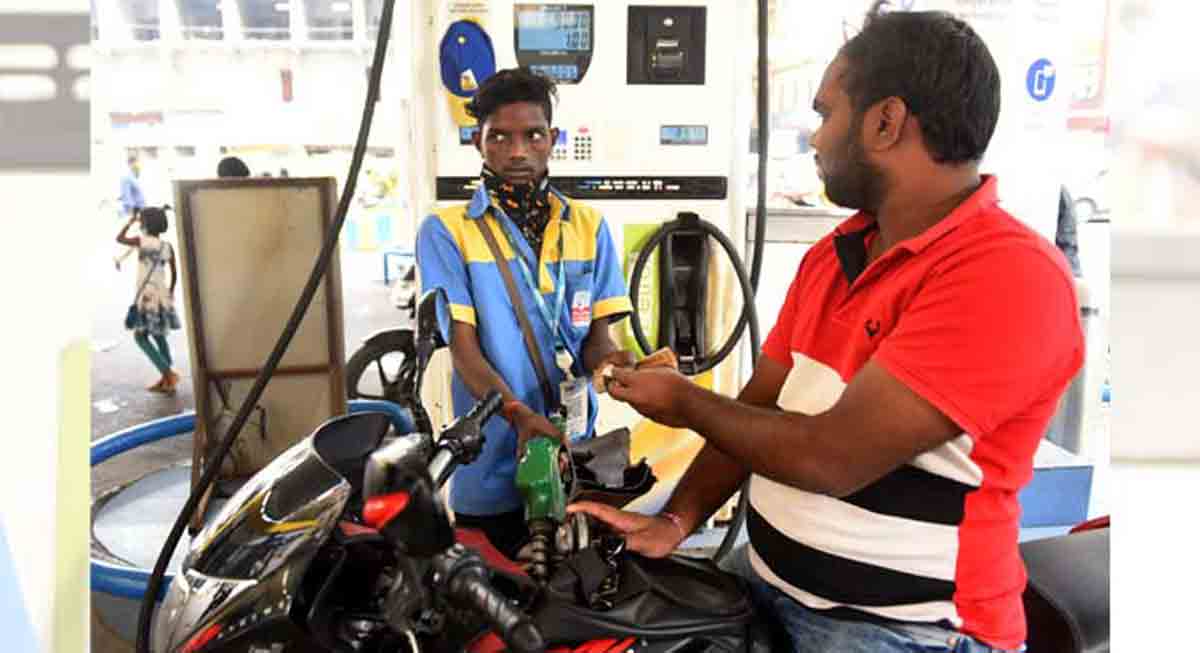


Hyderabad: There is a bigger game plan behind the recent decision of the Union Government in reducing the excise duty on petrol and diesel by Rs 5 and Rs 10 per litre respectively.
While the reduction is too little and too late considering the astronomical rise in fuel prices in the recent times, the Centre apparently aimed to derive a political mileage out of the move by trying to pressurise the States to reduce prices on their own. But what the ruling BJP has not considered is the possibility of reducing the Central Cess further or removing it completely. Incidentally, States do not get any share out of these central cess that the ruling BJP gleefullly went on increasing.
Here is the argument why Centre should reduce the duties further.
The Centre claimned all along that the rising petrol price are due to rising crude oil price in international markets. If this were so, how does one explain the much lower prices of petrol and diesel in India in 2013-14 when the average price of Indian basket of crude was US $105.52 per barrel. In 2013-14, petrol was retailing around Rs.77 per liter and diesel around Rs. 68 per liter.
The current price of Indian basket of crude is around US$83 per barrel, yet the prices of petrol and diesel have been much higher at Rs. 114.49 per litre of petrol and Rs.104.70 as on November 3, 2021 in Hyderabad. After the very moderate excise duty reduction, the prices have moderated very marginally to Rs.108.20 per litre of petrol and to Rs. 94.82 per litre of diesel. Thus, it is clear that unprecedented rise in petro prices cannot be attributed to rising crude prices.
The Central taxes consist of basic excise duty, special additional excise duty, commonly referred to as surcharge and road cess on a litre of petrol amounted to Rs.9.48 and Rs.3.56 per litre on diesel when the BJP Government assumed office in 2014. These were raised to Rs.10.43 per litre of petrol and Rs.4.52 per litre of diesel in 2014. In the very next year in 2015 the duties were raised by Rs.9.13 per litre of petrol and by Rs.6.66 per litre of diesel. The next major increase in Central taxes on petrol and diesel took place in 2020.
The Indian basket of crude oil prices witnessed a sharp fall from over US$ 109 in June 2014 to $33.36 per barrel in March 2020 and further to $30.61 per barrel in May 2020. Taking advantage of the sharp decline in iinternational oil prices, the Centre increased the cesses and surcharges to record levels.
In March 2020, the Centre hiked special additional excise duty by Rs.2 per litre on petrol and diesel and road cess by Re.1 each per litre. In May 2020, special additional excise duty on petrol was hiked by Rs 2 per litre and road cess by Rs 8 a litre. The increase in the special additional duty in respect of diesel was Rs.5 per litre and that of cess was Rs. 8 per litre. In the Union Budget 2021-22, Centre has levied an Agriculture Infrastructure and Development Cess (AIDC) of Rs 2.5 per litre on petrol and Rs 4 per litre on diesel.
Till November 3, 2021, total excise duties including cesses and surcharges amount to Rs. 32.90 per litre of petrol and Rs. 31.80 per litre of diesel. Out of this, the present levy of basic excise duty is only Rs.1.4 per litre of petrol and Rs.1.8 per litre of diesel, which is anomalous. Only basic excise duties are shareable with the States under the Finance Commission dispensation. It is a matter of serious concern that the Centre increased the excise duties on petrol by over 247 per cent and those on diesel by over 793 per cent between 2014 and 2020.
With the reduction in duties on November 3, 2021, the present excise duty is Rs.27.90 per litre of petrol and Rs.21.80 per litre of diesel.
The increases in Central excise taxes on petrol and diesel since the formation of the BJP Government in 2014 are summarised in Table 1.
| Effective Date | Petrol | Percentage Change | Diesel | Percentage Change |
| 14.09.2012 | 9.48 | 3.56 | ||
| 13.11.2014 | 11.02 | 16.24 | 5.11 | 43.54 |
| 03.12.2014 | 13.34 | 21.05 | 6.14 | 20.16 |
| 02.01.2015 | 15.40 | 15.44 | 8.20 | 33.55 |
| 17.01.2015 | 17.46 | 13.38 | 10.26 | 25.12 |
| 01.03.2015 | 17.46 | 0.00 | 10.26 | 0.00 |
| 07.11.2015 | 19.06 | 9.16 | 10.66 | 3.90 |
| 17.12.2015 | 19.36 | 1.57 | 11.83 | 10.98 |
| 02.01.2016 | 19.73 | 1.91 | 13.83 | 16.91 |
| 16.01.2016 | 20.48 | 3.80 | 15.83 | 14.46 |
| 31.01.2016 | 21.48 | 4.88 | 17.33 | 9.48 |
| 01.07.2017 | 21.48 | 0.00 | 17.33 | 0.00 |
| 04.10.2017 | 19.48 | -9.31 | 15.33 | -11.54 |
| 02.02.2018 | 19.48 | 0.00 | 15.33 | 0.00 |
| 05.10.2018 | 17.98 | -7.70 | 13.83 | -9.78 |
| 06.07.2019 | 19.98 | 11.12 | 15.83 | 14.46 |
| 14.03.2020 | 22.98 | 15.02 | 18.83 | 18.95 |
| 06.05.2020 | 32.98 | 43.52 | 31.83 | 69.04 |
| 02.02.2021 | 32.90 | -0.24 | 31.80 | -0.09 |
| % Increase from 2012 to February 2021 | 247.05 | 793.26 | ||
| 04.11.2021 | 27.90 | 21.80 |
There has been a significant change in the composition of excise duties in favour of cesses and surcharges. The details are furnished in Table 2.
| Effective Date | PETROL | DIESEL | ||||||||
| BED | SAED (Surcharge) | Road cess | Agri Infra Cess | Total | BED | SAED (Surcharge) | Road Cess | Agri Infra Cess | Total | |
| 01.03.2015 | 5.46 | 6.00 | 6.00 | 17.46 | 4.26 | 6.00 | 10.26 | |||
| 07.11.2015 | 7.06 | 6.00 | 6.00 | 19.06 | 4.66 | 6.00 | 10.66 | |||
| 17.12.2015 | 7.36 | 6.00 | 6.00 | 19.36 | 5.83 | 6.00 | 11.83 | |||
| 02.01.2016 | 7.73 | 6.00 | 6.00 | 19.73 | 7.83 | 6.00 | 13.83 | |||
| 16.01.2016 | 8.48 | 6.00 | 6.00 | 20.48 | 9.83 | 6.00 | 15.83 | |||
| 31.01.2016 | 9.48 | 6.00 | 6.00 | 21.48 | 11.33 | 6.00 | 17.33 | |||
| 01.07.2017 | 8.48 | 7.00 | 6.00 | 21.48 | 10.33 | 1.00 | 6.00 | 17.33 | ||
| 04.10.2017 | 6.48 | 7.00 | 6.00 | 19.48 | 8.33 | 1.00 | 6.00 | 15.33 | ||
| 02.02.2018 | 4.48 | 7.00 | 8.00 | 19.48 | 6.33 | 1.00 | 8.00 | 15.33 | ||
| 05.10.2018 | 2.98 | 7.00 | 8.00 | 17.98 | 4.83 | 1.00 | 8.00 | 13.83 | ||
| 06.07.2019 | 2.98 | 8.00 | 9.00 | 19.98 | 4.83 | 2.00 | 9.00 | 15.83 | ||
| 14.03.2020 | 2.98 | 10.00 | 10.00 | 22.98 | 4.83 | 4.00 | 10.00 | 18.83 | ||
| 06.05.2020 | 2.98 | 12.00 | 18.00 | 32.98 | 4.83 | 9.00 | 18.00 | 31.83 | ||
| 02.02.2021 | 1.40 | 11.00 | 18.00 | 2.50 | 32.90 | 1.80 | 8.00 | 18.10 | 4.00 | 31.80 |
| 04.11.2021 | 1.40 | 11.00 | 13.00 | 2.50 | 27.90 | 1.80 | 8.00 | 10.00 | 4.00 | 21.80 |
As indicated earlier, out of the excise duties, only proceeds of basic excise duty is shareable with the States. The Centre has been gradually reducing the basic excise duties on both petrol and diesel. The basic duty was reduced from Rs.9.48/litre in 2016 to Rs.1.40/litre in 2021. The reduction in the basic duty on diesel is from Rs.11.33/litre in 2016 to Rs.1.80/litre in 2021. Thus, the States’ divisible pool of taxes has been reduced resulting in llower tax devolutions to States.
In addition to excise duties, Centre levies customs duties on imported crude. India imports nearly 89 per cent of its crude oil requirements. In 2014-15, the customs duty on imported crude was Rs. 50 per metric tonne. Now, the duty stands increased by a Rupee.
Much of the increase in excise duties took place in March and May 2020 when the the Indian basket of crude oil prices witnessed a sharp fall from over US$ 109 in June 2014 to $33.36 per barrel in March 2020 and further to $30.61 per barrel in May 2020. There is a strong case for reducing the duties to soften the burden on the consumers and adverse impact of the high oil prices on the economy for the following reasons. There is a strong case for further reduction of duties by the Centre for the following reasons.
- Now the Indian basket of crude oil price is over US$83 per barrel compared to US$ 31.61 in May 2020, an increase of over 171 per cent.
- The contribution of petroleum sector (Customs and Excise) to Centre’s revenue increased from Rs.1,72,065 crore in 2014-15 to Rs.4,55,069 crore in 2020-21 (an increase of 165 per cent). In 2020-21 itself, petroleum revenue increased by over Rs.1,20,754 crore following the steep increase in the duties by the Centre. Significant portion of this revenue is not shareable with States.
- India’s consumption of petrol and diesel are now close to the pre-covid levels and are poised to increase with the signs of increase in economic activity and control of covid.
- The Centre’s revenues are more buoyant in the current year. In the first six months of the current fiscal year, revenue collections of the Centre amounted to Rs. 10.81 lakh crore (60.4% of the budget estimates as compared with 27.3% of the BE last year). The Centre’s expenditure in the first six months has been only 46.7% of the BE as compared with 48.6% of BE last year.
- The Centre’s fiscal deficit is only 35% of the BE in the first six months of the current year as compared with 114.8% in the corresponding period last year. Similarly, the revenue deficit is only 27.7% of BE as compared with 126.2% of BE last year.
- The States’ finances are already stretched and the revenue growth is only gradually picking up. The recent reductions in excise duties, however modest they are, will effect the VAT collections because of the ad valorem nature of the VAT rates. It is estimated that Telangana will loose around Rs.100 crore per month on account of reduction of excise duties on petrol and diesel.
- In Telangana, there was rationalization of VAT rates on Petrol and Diesel effective from January 17, 2015. The then prevailing rate of VAT of 31% + Rs.2/- per liter of petrol was fixed at 35.2%. Similarly, the rate of diesel was rationalized from 22.5% +Rs.2/- per liter to 27%. Since then, there has been no further revision in the rates of VAT on Petrol and Diesel.
- The excise duties on petrol and diesel continued to be higher even now. In Telangana, the incidence of VAT on a liter of petrol is Rs.27.25 as compared with the excise duty of Rs.27.90 post reduction. Similarly, the incidence of VAT on a liter of diesel is Rs.19.64 as compared with the Union excise incidence of Rs.21.80.
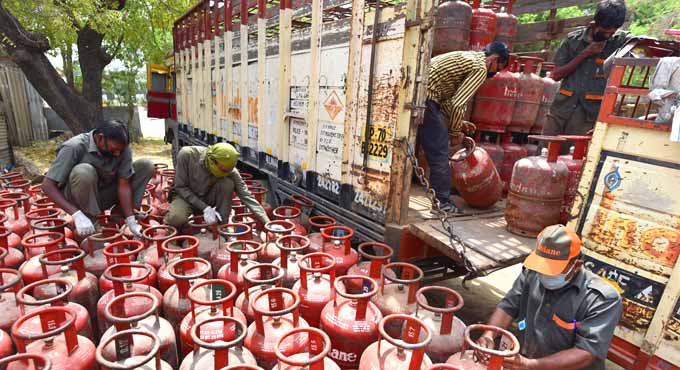
The Centre has not even spared the LPG from the levy of taxes. In 2013-14, there were no customs and excise duties on LPG. Now there is no basic customs duty on LPG for domestic use. But for non-domestic uses, the customs duty is 5 per cent. In addition, there is a 5 per cent countervailing customs duty on LPG. The GST is 5 per cent on LPG. Thus, there is a burden of 10 per cent on the domestic users of LPG now. This along with the increase in international prices has resulted in the hike in LPG prices. Now the price of subsided 14.2 kg. LPG cylinder is Rs.952 in Hyderabad. In a written reply to a number of questions, the Union petroleum Minister indicated that the price of 14.2 kg. LPG cylinder was Rs. 410.50 on March 1, 2014. The current price is higher by nearly 132 per cent. Thus, there is a case for reducing the taxes on subsidized LPG cylinders along with the taxes on petrol and diesel.
Also read:
Withdraw cess on petrol, diesel now, KCR to Centre
Scrap farm laws, CM KCR to Centre
Now you can get handpicked stories from Telangana Today on Telegram everyday. Click the link to subscribe.
Click to follow Telangana Today Facebook page and Twitter .

Related News