Rewind: Gloomy in the lives behind the loom—giving Telangana’s weavers their due
From Pochampally and Gadwal to Narayanpet and Siddipet, Telangana’s handloom traditions carry generations of skill, but recognition seldom translates into fair incomes for weavers


By Akhilesh Kumar
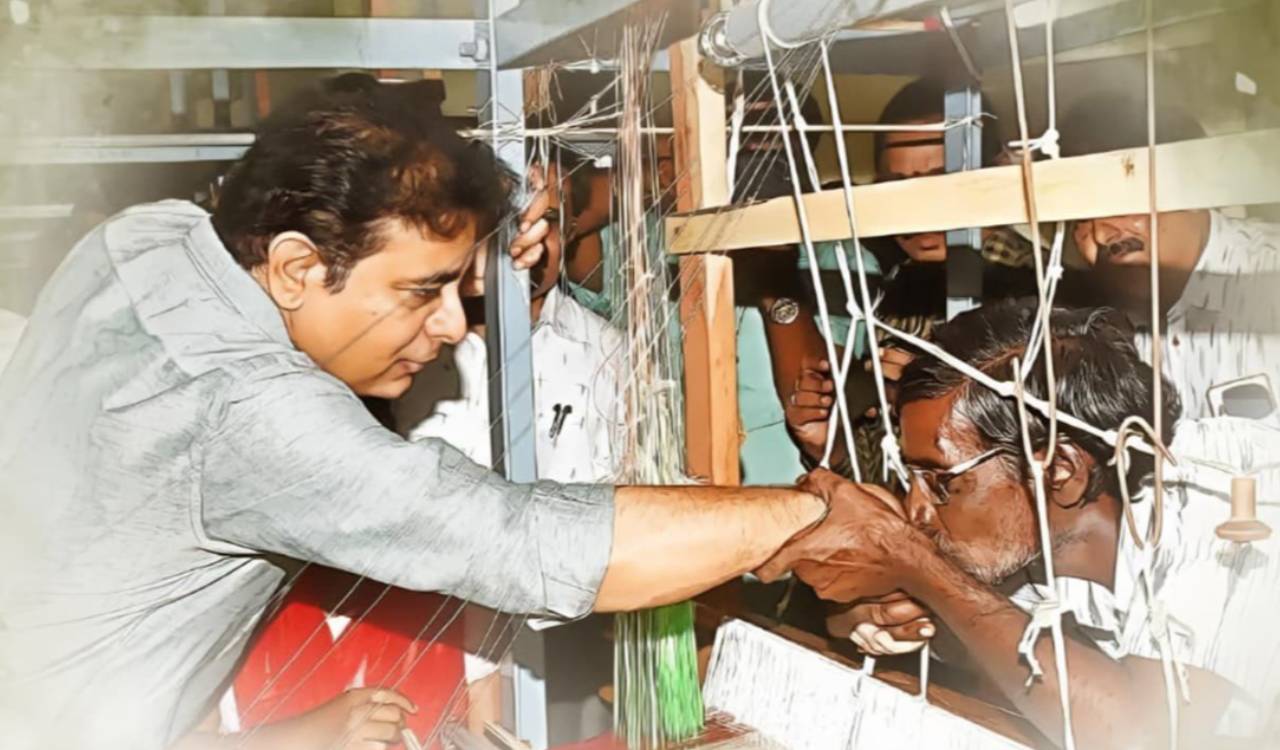
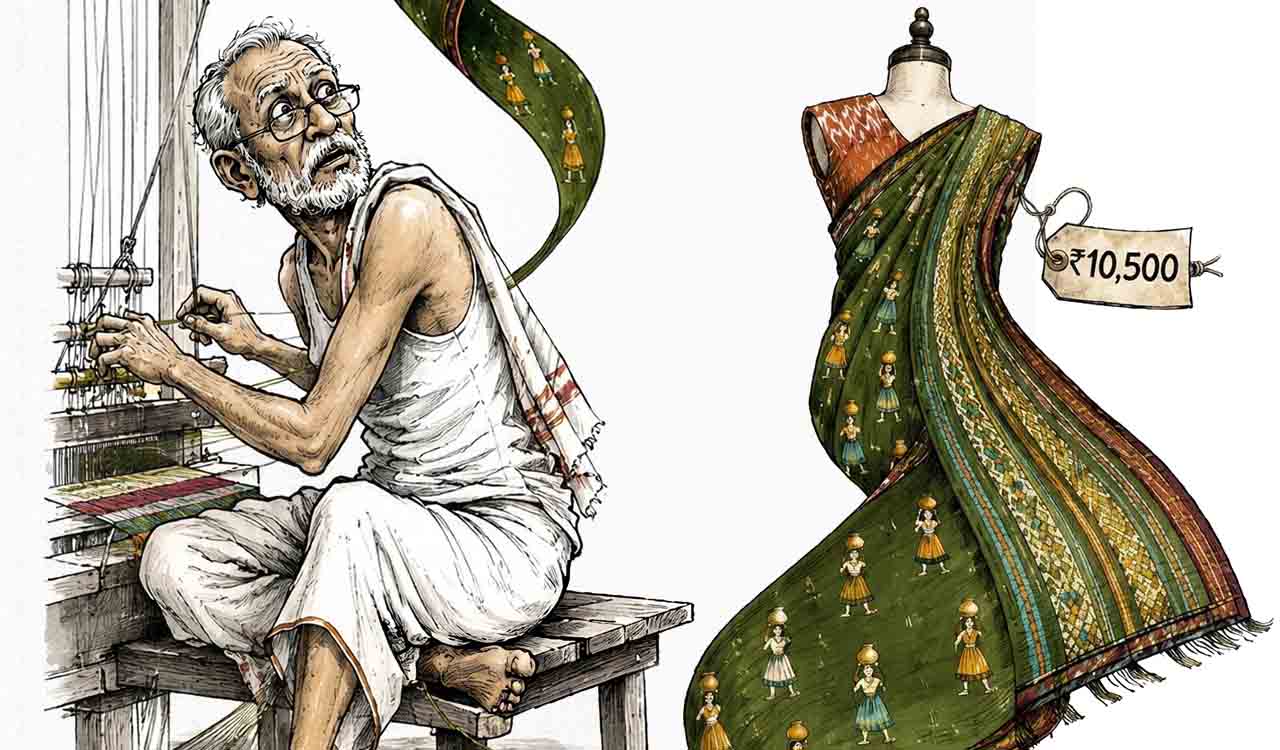
Suresh’s hands move swiftly across the loom, weaving threads together, transforming them into a six-yard heritage piece. In about 25 days, his Ikat-weaving family can produce seven sarees. Yet, the household earns just Rs 10,000-12,000 from them. The income is hardly enough to meet household expenses. Suresh says rising input costs and changes in taxes on cotton have only added to the pressure.
Also Read
Suresh’s story is not an isolated one. Behind every saree lies the cost of yarn, dyes, labour, and the financial risk of producing each piece. Despite the effort that goes into making these sarees, the economics of weaving are becoming increasingly difficult.
From Pochampally Ikat and Gadwal sarees to Narayanpet textiles and Siddipet’s Gollabhama sarees, handloom is deeply woven into Telangana’s cultural identity. But behind the celebrated sarees, intricate designs and Geographical Indication (GI) tags lies a more difficult question: can Telangana’s handloom traditions survive unless the people who produce them sustain themselves?
According to the Telangana Handlooms and Textiles Department, the State has around 59,325 handloom weavers and ancillary workers, along with approximately 42,500 powerlooms and around 500 weavers’ cooperative societies. These figures represent not merely an industrial sector but thousands of households whose livelihoods remain tied to weaving and allied activities.
Telangana’s handloom story is also a story of remarkable diversity. Pochampally Ikat has become perhaps the State’s most recognisable textile identity, while Gadwal sarees are known for their distinctive weaving traditions. Narayanpet has its own long-standing textile heritage, and Siddipet’s Gollabhama sarees have acquired GI recognition. These traditions demonstrate that weaving is not simply a method of producing cloth; it is also a form of cultural knowledge transmitted across generations.
Keeping the Loom Alive
National Handloom Day (August 7) often brings attention to the finished product. Sarees are displayed, exhibitions are organised, handlooms are promoted, and consumers are encouraged to purchase indigenous textiles. All of this is important. But the conversation should not end with the product. The more fundamental question is about the weaver behind the product.
Rising input costs are one of the most immediate concerns. Ramesh, a Pochampally silk weaver, described rising prices of silk yarn, cotton and chemical dyes as one of the biggest pressures facing small producers. For them, the difficulty begins even before the weaving starts: purchasing raw materials can require borrowing, while irregular orders make repayment difficult.
The imbalance between the labour invested in intricate designs and the amount received from local traders and intermediaries also weighs heavily on weavers. Anil, a traditional weaver from Puttapaka, says intricate designs involve days of work, yet local traders and intermediaries often determine the price at which the weaver’s work changes hands.
The problem becomes particularly visible when one examines the economics of an individual saree. A traditional Gadwal saree easily takes up to five days of intensive and highly skilled family labour. Raw materials account for approximately Rs 3,200 while around Rs 1,200 goes towards labour, taking the production cost to about Rs 4,400. Once the saree moves through wholesale and retail channels, with transportation, urban showroom expenses and retail margins added, it eventually reaches customers at approximately Rs 9,500-11,000.
This varies from saree to saree depending on yarn, zari, design, quality and labour time. The example nevertheless reveals the considerable distance between the value of the finished product and the income of the person who produces it.
Price of Survival
Pochampally offers perhaps the clearest illustration of the paradox facing the handloom sector. Pochampally Ikat has acquired considerable national and international recognition and has become one of the strongest symbols of the State’s textile heritage.
However, recognition of a textile does not necessarily mean adequate remuneration for the person who produces it. Traditional handloom products increasingly compete with machine-made textiles that can reproduce patterns at lower prices and in much larger quantities. For consumers, the difference between a genuine handwoven product and a mechanically produced imitation is not always immediately visible.
Ravi, an artisan from Siddipet, says buyers often do not understand why an authentic handloom product must cost more. The challenge, therefore, is not merely to protect a design. It is to protect the livelihood attached to that design.
Exhibitions are steps in the right direction and can bring weavers closer to consumers and create opportunities for direct sales. But occasional exhibitions alone cannot resolve the structural problem of market access. The question of who buys the finished product is equally important. Government support can provide an important market and promotional mechanism, but many artisans continue to depend heavily on private traders and intermediaries. This dependence can leave weavers with limited control over pricing. A stronger direct-market ecosystem could allow producers to retain a larger share of the value created by their labour.
The Jogulamba Gadwal district administration has 24 registered primary weavers’ cooperative societies and more than 2,000 geo-tagged looms. The district has also implemented various welfare measures for weavers. Narayanpet has its own long-standing textile identity, marked by distinctive borders and checked bodies reflecting the region’s historical influences. Yet, it does not enjoy the same level of visibility as Pochampally and Gadwal.
Siddipet’s Gollabhama saree represents another distinctive tradition. Its defining feature is the Gollabhama, or milkmaid, motif associated with the region’s pastoral communities. Rather than simply printing the figure onto the fabric, weavers create the motif through an intricate extra-weft technique, incorporating additional coloured threads into the textile itself. The skill involved is considerable, but the economic return can be modest.
A cotton Gollabhama saree can require three to four days of intensive work, while artisans working through middlemen may receive only a few hundred rupees for producing a piece that can eventually reach urban markets for several thousand rupees. For the artisan, the problem is, therefore, not a lack of cultural value. It is the inability to convert that cultural value into a sustainable income.
Lesser-Known Traditions
Telangana’s textile landscape also contains several lesser-known traditions that deserve much greater public attention. The Puttapaka Telia Rumal, associated with the Nalgonda region, is one such example. It is a distinctive double-Ikat tradition involving an elaborate yarn-conditioning process before weaving. Traditional treatment using materials such as castor oil and ash contributes to its characteristic texture and finish. The technique embodies generations of specialised knowledge that cannot easily be recreated once the community practising it disappears.
Further east, Mahadevpur Tussar silk represents another lesser-known textile tradition associated with the Godavari region, while Amarchinta silk sarees from Wanaparthy district are known for fine silk and intricate zari work. These traditions demonstrate that Telangana’s textile heritage cannot be reduced to a handful of commercially successful names. Yet, obscurity itself can become a threat.
When a craft remains unknown to consumers, the market for it remains narrow. When the market remains narrow, younger members of artisan families have fewer incentives to inherit an occupation that requires considerable skill but offers uncertain returns. The question of the younger generation may ultimately determine whether Telangana’s handloom traditions survive.
For many weaving families, the occupation has historically been transmitted from parents to children. But cultural inheritance alone cannot persuade a young person to remain in a profession if it does not provide a stable and dignified livelihood.
In Sircilla, one of Telangana’s important textile centres, Manjula, the wife of a 47-year-old weaver, describes how her husband’s inability to repay borrowed money was connected to the absence of a stable livelihood. The family’s struggle was not simply an occupational problem; it affected his ability to support his wife and two sons.
These experiences reveal that the handloom crisis is not simply about textiles. It is about household income, debt, children’s futures, social security and the willingness of the next generation to inherit the occupation. The State has established an important welfare architecture for weavers. Its initiatives include the thrift fund, Chenetha Mithra, insurance support and measures aimed at reducing indebtedness.
The implementation of these schemes at the district level offers an indication of their importance. In Wanaparthy, for instance, 641 weavers and ancillary workers were enrolled under the Nethanna Podupu/Thrift Fund. Under Nethanna Bima, eligible weavers receive insurance coverage of Rs 5 lakh. Such interventions matter because handloom is not simply an employment category. For many families, the loss of a weaver can mean the loss of the principal source of income.
Economic Ecosystem
Telangana has already built an important foundation through its welfare and promotional schemes. The next stage should focus on creating a stronger economic ecosystem around its handloom clusters.
First, weavers need greater access to direct markets, reducing excessive dependence on intermediaries. Second, GI recognition must be accompanied by stronger mechanisms to protect genuine handloom products from misleading imitations and greater consumer awareness about the labour involved in authentic handloom production. Third, government exhibitions should be connected to permanent digital and physical marketplaces rather than functioning only as occasional promotional events.
Fourth, handloom clusters need greater investment in design, packaging, branding and contemporary product development, while ensuring that innovation does not erase the traditional character of the craft. Fifth, social security must remain central. Insurance, savings schemes, credit support and debt relief are not peripheral welfare measures; they are essential to the survival of the sector. Finally, Telangana should treat its handloom clusters as part of a broader cultural and economic tourism strategy.
Pochampally demonstrates how an established weaving cluster can be transformed into a cultural and experiential tourism destination. Telangana Tourism’s dedicated Pochampally Handloom Tour provides visitors with opportunities to experience handloom weaving firsthand and visit the museum, enabling them to understand the craftsmanship.
Gadwal, Narayanpet, Siddipet and other weaving centres can also become places where visitors do not merely purchase a saree but understand the people, skills and histories behind it. Such an approach could also change the relationship between the consumer and the product. A saree would no longer be viewed simply as a commodity but as the product of skilled labour, inherited knowledge and a household’s economic realities.
National Handloom Day provides an opportunity to celebrate India’s weavers and weaves. But celebration should also invite introspection.
- Note: Names of weavers have been changed to protect their privacy.
(The author is pursuing his PhD from Jamia Millia Islamia, New Delhi, and is an independent researcher)
Related News